If you’ve ever moved from full-time to part-time work, started a job midway through the month, or negotiated reduced hours, you’ve probably run into one confusing question: “What will I actually get paid?”
That’s where a pro rata calculator UK comes in. It takes your full-time salary and works out exactly what you’re entitled to based on the hours or days you actually work. No guesswork, no awkward payroll surprises.
In this guide, we’ll break down the pro rata salary formula in plain English, walk through real examples (part-time roles, mid-month starts, maternity return, holiday pay), and show you exactly how to calculate it yourself — with or without a calculator.
What Does “Pro Rata” Actually Mean?
“Pro rata” is Latin for “in proportion.” In UK employment terms, it means your pay, holiday entitlement, or benefits are calculated in proportion to the full-time equivalent.
So if a job is advertised as “£30,000 per annum, pro rata”, that £30,000 is the full-time salary. If you’re working 3 days a week instead of 5, you won’t earn £30,000 — you’ll earn a proportion of it based on your actual hours.
This matters because many job adverts list the full-time figure, which can be misleading if you’re applying for a part-time role. Understanding pro rata pay means you know your real take-home before you accept an offer.
The Pro Rata Salary Formula
The standard formula used across the UK is:
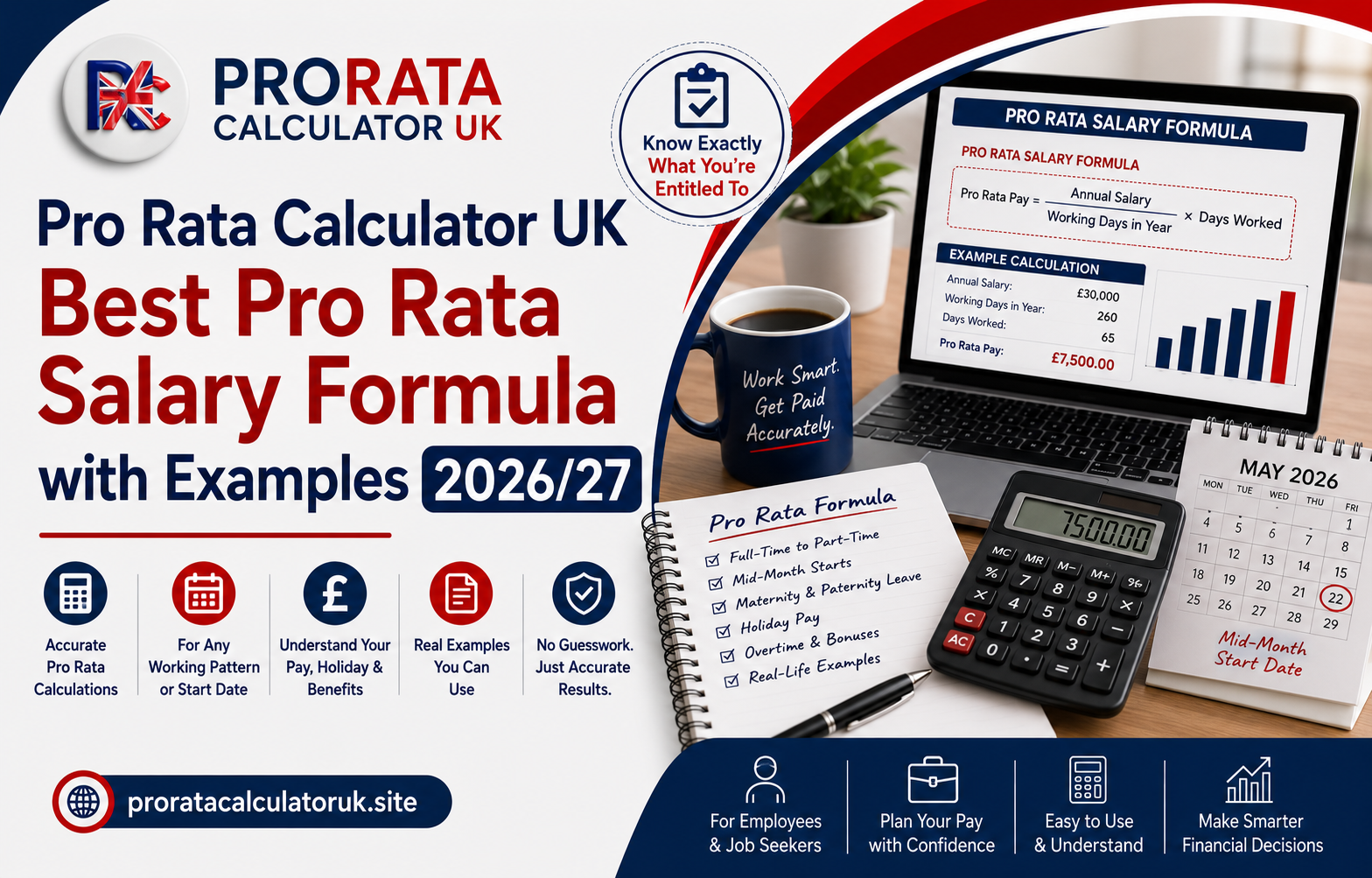
Pro Rata Salary = (Full-Time Salary ÷ Full-Time Hours) × Actual Hours Worked
Or, if you’re working a set number of days rather than hours:
Pro Rata Salary = (Full-Time Salary ÷ Full-Time Days) × Actual Days Worked
Most UK employers use a standard 37.5 or 40-hour week as the full-time benchmark, and a 5-day week as standard for day-based roles. Always check your contract, since this baseline can vary between employers.
Visit Now: MauricetteCalculetteQuick Example
Let’s say the full-time salary for a role is £28,000 based on a 37.5-hour week, and you’re offered 22.5 hours a week (3 days).
£28,000 ÷ 37.5 = £746.67 per hour-week unit
£746.67 × 22.5 = £16,800 per year
So your pro rata salary would be £16,800, even though the job was advertised at £28,000.
Step-by-Step: How to Calculate Pro Rata Pay
Here’s the process broken down so you can do it manually, then check it against a calculator.
- Find the full-time salary — this is usually stated in the job advert or contract as the FTE (full-time equivalent) figure.
- Find the full-time hours or days — check your contract; standard is often 37.5 or 40 hours, or 5 days.
- Divide the full-time salary by full-time hours/days — this gives you the value per hour or per day.
- Multiply by your actual hours/days worked — this gives your pro rata salary.
- Double-check against your payslip — pro rata figures should match what payroll calculates, so this is a good sanity check each pay cycle.
Common Pro Rata Scenarios
Pro rata calculations aren’t just for part-time jobs. Here are the situations where UK employees most often need this formula.
1. Part-Time Work
The most common scenario. If you work fewer days or hours than the standard full-time week, your salary, sick pay, and holiday entitlement are all pro rated.
2. Starting or Leaving Mid-Month
If you join a company on the 15th of the month, you’re only paid for the days you actually worked that month — not the full monthly salary.
Example: Full-time annual salary of £24,000, starting on the 16th of a 30-day month.
£24,000 ÷ 12 = £2,000 monthly salary
£2,000 ÷ 30 days = £66.67 per day
£66.67 × 15 days worked = £1,000 for that month
3. Maternity, Paternity, or Sick Leave Return
If you return to work part-way through a month or on reduced hours, pro rata calculations determine your pay for that transitional period.
4. Holiday Pay for Part-Time Staff
Holiday entitlement in the UK is also calculated pro rata. Full-time workers get a statutory minimum of 5.6 weeks’ paid holiday per year. Part-time workers get the same proportion based on their hours.
Example: A full-time employee gets 28 days’ holiday (5.6 weeks × 5 days). Someone working 3 days a week gets:
28 ÷ 5 = 5.6 days per week worked
5.6 × 3 = 16.8 days' holiday per year
Pro Rata Salary Table: Common Examples
Here’s a quick reference table using a £30,000 full-time salary (based on a 5-day week) at different part-time schedules.
| Days Worked Per Week | Pro Rata Salary | Percentage of Full-Time |
|---|---|---|
| 5 days (full-time) | £30,000 | 100% |
| 4 days | £24,000 | 80% |
| 3 days | £18,000 | 60% |
| 2 days | £12,000 | 40% |
| 1 day | £6,000 | 20% |
This kind of table is useful for quickly sanity-checking a job offer before you dig into the exact hours-based formula.
Read More: Rata Calculator UK-5 Easy Steps to CalculatePro Rata Pay vs Hourly Rate: What’s the Difference?
People often confuse pro rata salary with hourly rate, but they’re calculated slightly differently in practice.
- Pro rata salary takes an annual full-time figure and scales it down to your actual working pattern (still expressed as an annual or monthly salary).
- Hourly rate breaks a salary down into pay per hour, which is more relevant for zero-hours contracts, freelance work, or shift-based pay.
If you want to convert your pro rata salary into an hourly rate for comparison, divide your pro rata annual salary by your actual annual hours worked.
Why Pro Rata Calculations Matter for Job Offers
A lot of job seekers make the mistake of only looking at the headline salary figure in an advert. If a role says “£35,000 pro rata” and you’re applying for a 3-day-a-week position, you need to run the numbers before deciding if the offer works for you.
This is especially important when:
- Comparing part-time offers against full-time roles at other companies
- Negotiating a switch from full-time to part-time with your current employer
- Budgeting for a career change involving reduced hours
- Understanding your true earnings when returning from leave on flexible hours
Knowing the exact formula means you’re never caught off guard by your first payslip.
Read More:How Does a Rata Calculator UK WorkTax and National Insurance on Pro Rata Pay
Pro rata salary is taxed the same way as any other salary in the UK — through PAYE (Pay As You Earn). Your tax code and National Insurance contributions are based on your actual pro rata earnings, not the full-time equivalent figure.
One thing worth knowing: your Personal Allowance (the amount you can earn tax-free, currently £12,570) applies in full regardless of whether you work full-time or part-time. This means part-time and pro rata workers often keep a slightly higher proportion of their pay tax-free compared to their full-time counterparts, simply because they’re earning less overall.
Pro Rata Calculator vs Manual Calculation
You can absolutely work out pro rata pay by hand using the formula above, and for a single quick check, that’s often the fastest option. But a dedicated pro rata calculator UK tool has a few advantages worth knowing about:
- Fewer errors. Manual calculations are easy to get wrong when you’re switching between weekly, monthly, and annual figures, especially under time pressure while comparing job offers.
- Instant comparisons. A calculator lets you test multiple scenarios quickly — 3 days vs 4 days, 20 hours vs 25 hours — without redoing the maths each time.
- Built-in rounding rules. Payroll systems often round to specific decimal places or apply company-specific policies. A good calculator mirrors that, so the figure you see is closer to what actually lands in your account.
- Holiday and pension pro rata together. Some calculators also work out pro rata holiday entitlement and pension contributions in the same step, which saves you running separate sums.
That said, understanding the underlying formula still matters. A calculator is only as reliable as the numbers you feed into it, and knowing how the maths works means you can spot a mistake immediately if a figure looks off — whether that’s an error in the tool or in your own inputs.
Pro Rata Pay Across Different Sectors
Pro rata rules apply the same way in principle across the UK, but how they show up in practice can vary depending on your industry.
NHS and Public Sector Roles
NHS pay bands are usually quoted as full-time annual figures under Agenda for Change. Part-time staff, which make up a large share of the NHS workforce, have their salary, unsociable hours payments, and annual leave all calculated pro rata against the standard 37.5-hour week.
Teaching and Education
Teachers’ pay is often prorated not just by hours but by the proportion of the school year worked, since term-time-only contracts are common. A teacher working 0.6 FTE (three days a week, term-time only) will see their annual salary calculated against both the reduced hours and the reduced number of working weeks.
Retail and Hospitality
These sectors often use hourly contracts rather than annual salaries, so “pro rata” here usually applies more to holiday entitlement and any fixed weekly bonuses than to the base pay itself, since hourly staff are already paid strictly for hours worked.
Office and Corporate Roles
This is where pro rata salary calculations show up most often in job adverts, typically for part-time admin, marketing, HR, or finance positions advertised at a full-time equivalent salary with a note like “pro rata for X days.”
Common Mistakes When Calculating Pro Rata Pay
- Using the wrong full-time hours baseline. Some companies use 35 hours as full-time; others use 37.5 or 40. Always check the contract.
- Forgetting holiday entitlement is also pro rata. Don’t assume you get the same days off as a full-time colleague.
- Mixing up monthly and annual figures. Always confirm whether the salary you’re working from is annual or monthly before applying the formula.
- Ignoring pay rises or bonuses. These usually also need to be pro rated if you’re not full-time.
Read More:Ultimate Rata Calculator UK – Calculate Pay for Leaving Mid-Month (2026/27)What does pro rata mean on a payslip?
It means your pay has been calculated as a proportion of the full-time equivalent salary, based on the hours or days you actually worked.
How do I calculate pro rata salary for a part-time job?
Divide the full-time salary by full-time hours (or days), then multiply by the hours (or days) you actually work.
Is pro rata pay the same as hourly pay?
Not exactly. Pro rata pay is usually expressed as an annual or monthly salary scaled down, while hourly pay is a rate per hour worked.
Does pro rata affect holiday entitlement?
Yes. Holiday entitlement is also calculated pro rata based on your working pattern.
What’s a typical full-time hours baseline in the UK?
Most commonly 37.5 or 40 hours a week, though this varies by employer and industry.
How is pro rata salary calculated for someone starting mid-month?
Divide the monthly salary by the number of days in that month, then multiply by the days actually worked.
Do pro rata employees pay less tax?
They pay tax on their actual pro rata earnings, but their full Personal Allowance still applies, so a smaller proportion of their income may be taxed compared to full-time staff.
Can pro rata salary include bonuses?
Yes, most bonuses and pay rises should also be calculated pro rata for part-time staff, unless stated otherwise in the contract.
Is pro rata pay legal in the UK?
Yes, pro rata pay is standard practice and required under UK employment law to ensure part-time workers aren’t treated less favourably than full-time employees for the hours they work.
What if my contract doesn’t specify full-time hours?
Ask HR or check your company’s standard working week policy — this figure is essential for an accurate pro rata calculation.
Final Thoughts
Pro rata pay isn’t complicated once you understand the formula, but it’s easy to get wrong if you’re working from the wrong baseline hours or mixing up monthly and annual figures. Whether you’re comparing a part-time job offer, calculating pay for a mid-month start, or working out your holiday entitlement, the same simple formula applies:
Pro Rata Salary = (Full-Time Salary ÷ Full-Time Hours or Days) × Actual Hours or Days Worked
Run the numbers before you accept an offer, double-check your first payslip against them, and you’ll always know exactly what you’re being paid and why.