
Understanding how your pay is calculated when you don’t work a standard full-time schedule can be confusing. This is especially true for part-time employees, people who start or leave a job partway through a week, and workers whose hours change regularly.
A Weekly Pay Calculation helps you work out what you should earn for the hours or days you actually work. It is also useful when checking a pro rata salary, comparing part-time and full-time jobs, or estimating your gross weekly income.
In the UK, pro rata pay generally means that a part-time employee receives a proportion of the full-time salary based on their working hours. However, the exact calculation depends on how the employer defines full-time hours and how the pay period is structured.
This guide explains how to calculate weekly pay, how pro rata weekly salary works, and how to deal with common working patterns.
What Is Weekly Pay Calculation?
Weekly pay calculation is the process of determining how much you earn for one week of work.
For an employee paid hourly, the calculation is usually straightforward:
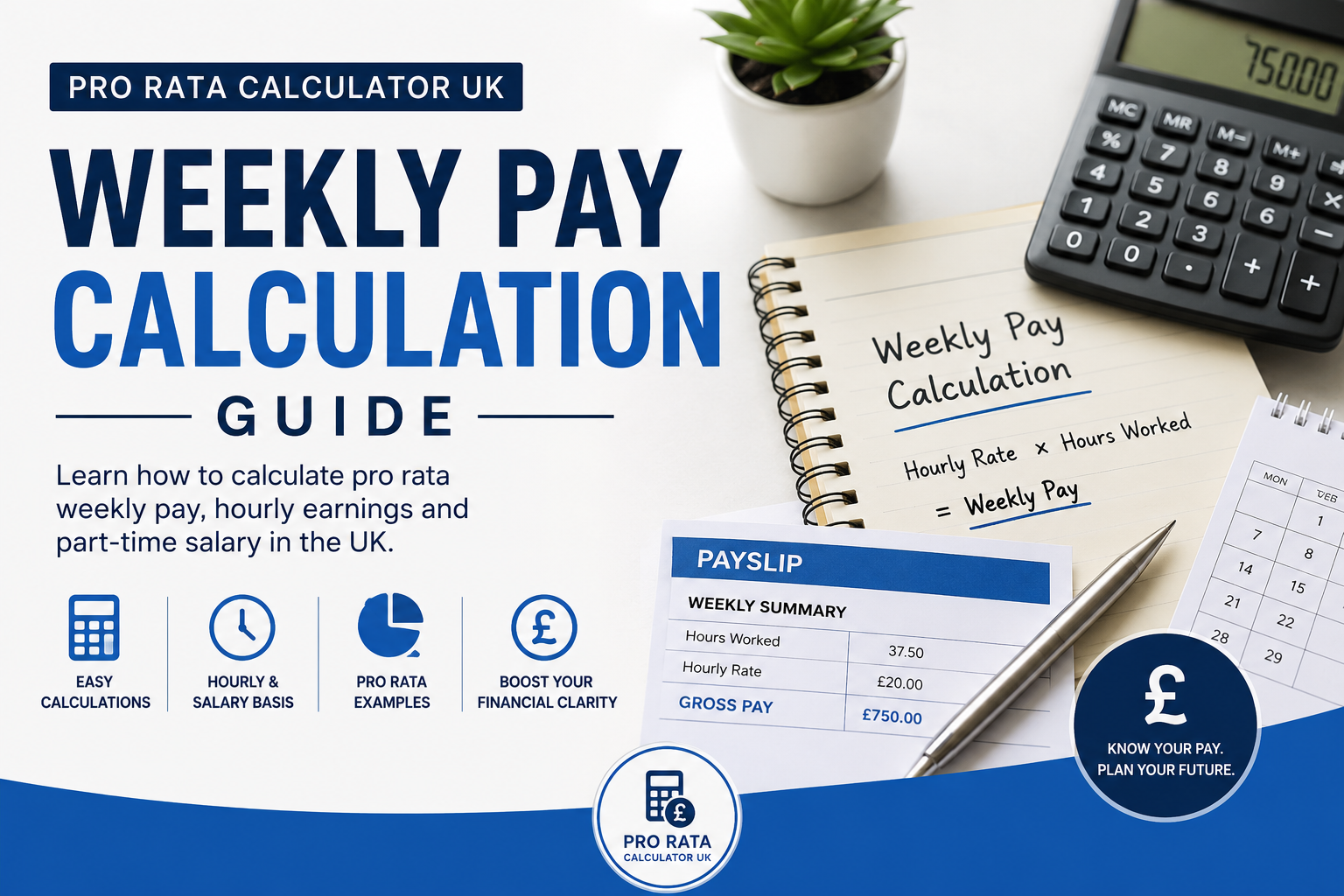
Weekly pay = Hourly rate × Hours worked per week
For example, if you earn £15 per hour and work 30 hours:
£15 × 30 = £450
Your gross weekly pay is £450 before deductions such as Income Tax, National Insurance and pension contributions.
For salaried employees, weekly pay can be calculated by converting the annual salary into a weekly amount:
Weekly pay = Annual salary ÷ 52
For example, a £31,200 annual salary gives:
£31,200 ÷ 52 = £600 per week
This assumes 52 equal weekly payments. Some employers use different payroll arrangements, so your actual payslip may not always match this simple calculation.
Visit Now: Mauricette CalculetteWhat Does Pro Rata Mean in the UK?
“Pro rata” means in proportion.
If a full-time employee earns £36,000 for a standard 40-hour working week, someone working 20 hours per week may receive half of that salary if the role is paid strictly on a pro rata basis.
The calculation is:
20 ÷ 40 = 0.5
Then:
£36,000 × 0.5 = £18,000
The part-time employee’s equivalent annual salary would therefore be £18,000.
Pro rata calculations are commonly used for:
- Part-time employment
- Reduced working hours
- Job shares
- Term-time employment
- Employees starting or leaving during a pay period
- Changes from full-time to part-time hours
- Some fixed-term employment arrangements
The important point is that pro rata does not always mean simply dividing a salary by two. You need to compare the employee’s contracted hours with the full-time hours used for the role.
Read Now: Pro Rata Calculator UK- Evening Shift SalaryHow to Calculate Weekly Pay
The easiest method depends on whether you are paid hourly or have an annual salary.
Method 1: Hourly Paid Workers
If you are paid by the hour, use:
Weekly pay = Hourly rate × Weekly hours
Example: 35 Hours Per Week
Suppose you earn £14.50 per hour and work 35 hours each week.
| Calculation | Amount |
|---|---|
| Hourly rate | £14.50 |
| Hours per week | 35 |
| Weekly pay | £507.50 |
£14.50 × 35 = £507.50
Your gross weekly pay is £507.50.
This calculation does not account for unpaid breaks, overtime, bonuses or deductions. You should use the hours for which you are actually paid.
Method 2: Annual Salary
If you know your annual salary and want to estimate weekly gross pay:
Weekly pay = Annual salary ÷ 52
For example:
£39,000 ÷ 52 = £750
So an annual salary of £39,000 is equivalent to £750 gross per week when divided across 52 weeks.
Method 3: Monthly Salary
If you are paid monthly, you can first calculate your annual salary:
Annual salary = Monthly salary × 12
Then:
Weekly pay = Annual salary ÷ 52
For example, if your gross monthly salary is £2,600:
£2,600 × 12 = £31,200
Then:
£31,200 ÷ 52 = £600
Your equivalent weekly gross pay is £600.
How to Calculate Pro Rata Weekly Pay
If you are working part-time, compare your contracted weekly hours with the full-time weekly hours.
The basic formula is:
Pro rata weekly pay = Full-time weekly pay × (Part-time hours ÷ Full-time hours)
Example: Part-Time Employee
Suppose the full-time salary is £40,000 and full-time employees work 40 hours per week.
First calculate full-time weekly pay:
£40,000 ÷ 52 = £769.23
Now suppose you work 24 hours per week.
Your pro rata proportion is:
24 ÷ 40 = 0.6
Then:
£769.23 × 0.6 = £461.54
Your equivalent gross weekly pay is approximately £461.54.
You can also calculate the annual pro rata salary first:
£40,000 × 0.6 = £24,000
Then:
£24,000 ÷ 52 = £461.54
Both approaches produce the same result.
Read More: Pro Rata Calculator UK- Civil Service SalaryWeekly Pay Calculation for Different Working Hours
The following example shows how the same full-time salary can produce different pro rata salaries depending on weekly hours.
Assume:
- Full-time salary: £36,000
- Full-time hours: 40 hours per week
- 52 weeks per year
Full-time weekly pay:
£36,000 ÷ 52 = £692.31
| Weekly Hours | Pro Rata Percentage | Annual Salary | Weekly Pay |
|---|---|---|---|
| 40 | 100% | £36,000 | £692.31 |
| 32 | 80% | £28,800 | £553.85 |
| 30 | 75% | £27,000 | £519.23 |
| 24 | 60% | £21,600 | £415.38 |
| 20 | 50% | £18,000 | £346.15 |
| 16 | 40% | £14,400 | £276.92 |
This table shows why knowing full-time hours matters when calculating pro rata pay.
How to Calculate Weekly Pay From Daily Hours
Some workers have a daily working pattern rather than a fixed weekly number of hours.
For example, suppose you work:
- Monday: 7 hours
- Tuesday: 7 hours
- Wednesday: 7 hours
- Thursday: 7 hours
- Friday: 4 hours
Your total weekly hours are:
7 + 7 + 7 + 7 + 4 = 32 hours
If your hourly rate is £13.50:
32 × £13.50 = £432
Your gross weekly pay is £432.
This method is particularly useful for employees whose working hours vary by day but are agreed in advance.
How to Calculate Pay for Fewer Than Five Working Days
You may also need a weekly pay calculation when you work fewer days than a full-time employee.
For example, suppose full-time employees work five days per week and earn £35,000 per year.
You work three days per week.
Your pro rata proportion is:
3 ÷ 5 = 0.6
Your pro rata annual salary is:
£35,000 × 0.6 = £21,000
Your equivalent weekly salary is:
£21,000 ÷ 52 = £403.85
However, this approach is appropriate only when the employment arrangement is based on equal working days. If your working days contain different numbers of hours, calculating based on hours is generally more precise.
Read More: Pro Rata Calculator UK- Term-Time Only SalaryWeekly Pay Calculation When Starting a Job Midweek
Starting a job partway through a week can require a different calculation.
For hourly workers, simply calculate the hours actually worked.
For example, you earn £16 per hour and start on Thursday:
| Day | Hours Worked | Pay |
|---|---|---|
| Thursday | 7 | £112 |
| Friday | 7 | £112 |
| Total | 14 | £224 |
14 × £16 = £224
For salaried workers, the employer may use a specific payroll method to calculate part-period pay. There is no single universal formula that every UK employer must use for every situation.
Your employment contract or payroll policy may specify whether the employer uses calendar days, working days, contractual hours or another method.
Weekly Pay When Leaving a Job
The same issue can arise when an employee leaves employment during a pay period.
If you are paid hourly, your final pay is generally based on the hours you are entitled to be paid for, plus any other amounts due.
For salaried workers, the employer needs to calculate the portion of salary earned up to the leaving date.
For example, if your annual salary is £31,200:
£31,200 ÷ 52 = £600 weekly equivalent
But the amount actually included in your final payslip depends on the employer’s payroll calculation and the dates involved.
Final pay can also include or deduct other amounts, such as:
- Unused holiday entitlement
- Overtime
- Bonuses that have become payable
- Approved expenses
- Salary advances
- Contractual deductions
Therefore, a simple weekly salary calculation should be treated as an estimate rather than a guaranteed final payslip amount.
Is Pro Rata Pay the Same as Hourly Pay?
No.
Hourly pay is based directly on the number of hours you work.
Pro rata salary takes a full-time salary and applies a proportion based on your contracted working pattern.
For example, an employee may have a full-time equivalent salary of £40,000 but work 25 hours per week instead of 40.
Their salary could be:
£40,000 × (25 ÷ 40) = £25,000
Their weekly equivalent is:
£25,000 ÷ 52 = £480.77
The employee is therefore receiving a pro rata salary rather than simply being described as an hourly worker.
This distinction can matter when comparing job offers, calculating annual income or checking whether a part-time salary has been calculated correctly.
What Is Gross Weekly Pay?
Gross weekly pay is the amount you earn before deductions.
Depending on your circumstances, deductions from gross pay can include:
- Income Tax
- Employee National Insurance
- Workplace pension contributions
- Student loan repayments
- Other authorised deductions
For example:
Gross weekly pay: £600
Your take-home pay will normally be lower because applicable deductions are taken through payroll.
This is why you should not confuse weekly gross pay with your actual amount received in your bank account.
A Weekly Pay Calculation normally refers to gross earnings unless the calculation specifically states that it is estimating net or take-home pay.
How Overtime Affects Weekly Pay
If you work more than your normal contracted hours, overtime may increase your weekly earnings.
Suppose your standard hourly rate is £15 and you work 40 normal hours plus 5 hours of overtime.
If your employer pays overtime at 1.5 times your normal rate:
£15 × 1.5 = £22.50
Your normal pay is:
40 × £15 = £600
Your overtime pay is:
5 × £22.50 = £112.50
Total weekly gross pay:
£600 + £112.50 = £712.50
Overtime rates depend on your employment contract or workplace policy. Overtime is not automatically paid at time-and-a-half simply because you work additional hours.
Does Weekly Pay Include Holiday Pay?
It depends on the circumstances.
Holiday pay is separate from your ordinary weekly salary calculation, although holiday pay can affect the amount you receive in a particular pay period.
For employees with regular hours, holiday pay is generally based on the pay rules that apply to their employment.
Workers with irregular hours or part-year working arrangements can have different holiday entitlement and holiday pay calculations.
If you are using a pro rata calculator to estimate your regular weekly salary, do not automatically add holiday pay to the result unless your pay arrangement specifically requires it.
Weekly Pay and the National Minimum Wage
When calculating pay, it is important to distinguish between your overall salary and the legal minimum hourly rate.
The UK’s National Minimum Wage and National Living Wage rules apply to eligible workers. Whether your pay meets the applicable minimum depends on factors including your age and employment status.
For this reason, a pro rata salary calculation should not be used by itself to determine whether an employer is complying with minimum wage requirements.
If you are checking your pay against the National Minimum Wage, calculate your relevant hourly pay using the hours and pay that count under the applicable rules.
Weekly Pay Calculation for Term-Time Workers
Term-time employment is another situation where pro rata calculations can become complicated.
A term-time worker may work only during school terms but receive their salary in regular monthly payments throughout the year.
For example, a role might have a full-time equivalent salary of £30,000, while the employee works a reduced number of hours and only for part of the year.
The final salary may depend on:
- Full-time annual salary
- Contracted weekly hours
- Full-time weekly hours
- Weeks actually worked
- Holiday entitlement
- The employer’s payroll arrangements
Therefore, simply multiplying weekly hours by an hourly rate may not reproduce the figure shown on the employment contract.
For term-time and part-year roles, always check how the employer has calculated the stated annual salary.
Read More: Rata Calculator UK- Zero-Hour Contract Pay ExplainedCommon Weekly Pay Calculation Mistakes
Using 52 weeks for every situation
Dividing an annual salary by 52 is useful for finding an equivalent weekly amount, but it does not mean every employee is paid weekly.
A monthly-paid employee will normally receive 12 payments rather than 52.
Ignoring contracted hours
If a full-time role is 37.5 hours per week, do not automatically compare a part-time worker’s hours with 40 hours.
Use the full-time hours that apply to the relevant job or contract.
Confusing gross and net pay
A £500 weekly salary does not necessarily mean £500 reaches your bank account. Tax, National Insurance and other deductions may reduce take-home pay.
Assuming overtime is always included
Your basic pro rata salary calculation should normally be based on contracted pay. Overtime should be added separately when applicable.
Rounding too early
Keep decimal figures during the calculation and round the final result to the nearest penny. Early rounding can create small differences in the final salary.
How a Pro Rata Calculator UK Can Help
A Pro Rata Calculator UK can make these calculations much quicker.
You typically need information such as:
- Full-time annual salary
- Full-time weekly hours
- Your weekly hours
- Number of working weeks, where relevant
- Hourly rate, if applicable
The calculator can then estimate your:
- Pro rata annual salary
- Weekly pay
- Monthly equivalent
- Hourly equivalent
For a straightforward part-time role, the basic calculation is:
Pro rata salary = Full-time salary × (Your hours ÷ Full-time hours)
Once the annual pro rata salary is known:
Weekly pay = Pro rata annual salary ÷ 52
This is particularly useful when comparing a full-time job with a part-time offer.
When Should You Use a Weekly Pay Calculation?
A weekly calculation can be useful when:
- Comparing two job offers
- Checking a payslip
- Estimating part-time earnings
- Converting annual salary into weekly income
- Calculating pro rata pay
- Working out the effect of changing your hours
- Estimating overtime earnings
- Planning a household budget
- Comparing hourly and salaried employment
It can also help you understand how a quoted annual salary translates into regular earnings.
How do I calculate my weekly salary from annual salary?
Divide your annual salary by 52.
For example:
£36,400 ÷ 52 = £700 per week
This gives you an equivalent gross weekly salary.
How do I calculate pro rata weekly pay?
First calculate the proportion of full-time hours you work:
Your hours ÷ Full-time hours
Then multiply the result by the full-time weekly salary.
For example, working 25 hours compared with 40 full-time hours gives:
25 ÷ 40 = 62.5%
If full-time weekly pay is £800:
£800 × 62.5% = £500
Your pro rata weekly pay is £500.
How do I calculate weekly pay from an hourly rate?
Multiply your hourly rate by your paid weekly hours.
If you earn £14 per hour and work 30 hours:
£14 × 30 = £420
Your gross weekly pay is £420.
Is pro rata salary based on hours or days?
It can be based on either, depending on the working arrangement. If working days contain different numbers of hours, hours are usually more useful for calculating the proportion.
Always check the employer’s stated full-time working pattern.
Does pro rata pay include tax?
No. Pro rata pay calculations normally calculate gross pay. Income Tax, National Insurance and other deductions are then handled through payroll.
Can my weekly pay change even if my annual salary stays the same?
Yes. Your payslip can vary because of overtime, unpaid leave, bonuses, deductions, holiday pay or other payroll adjustments. Your contracted annual salary may remain unchanged.
What is the easiest way to calculate weekly pay?
For hourly workers, use:
Hourly rate × Hours worked
For salaried workers:
Annual salary ÷ 52
For part-time salaried workers, calculate the pro rata annual salary first and then divide it by 52.
Final Thoughts
A reliable Weekly Pay Calculation starts with understanding how your pay is structured. Hourly employees can usually multiply their hourly rate by their paid weekly hours, while salaried employees can divide their annual salary by 52 to find an equivalent weekly figure.
For part-time employment, the key is to compare your contracted hours with the full-time hours for the role. Once you know the correct proportion, you can calculate your pro rata annual salary and convert it into an estimated weekly amount.
Remember that these calculations normally show gross pay, not take-home pay. Tax, National Insurance, pension contributions and other deductions can change the amount you actually receive.
If your working arrangement includes term-time work, irregular hours, overtime, or a mid-period start or finish date, the employer’s payroll method and contract terms can make the calculation more complex. In those situations, use the basic formula as a guide and check your employment documents or payslip for the exact calculation.