
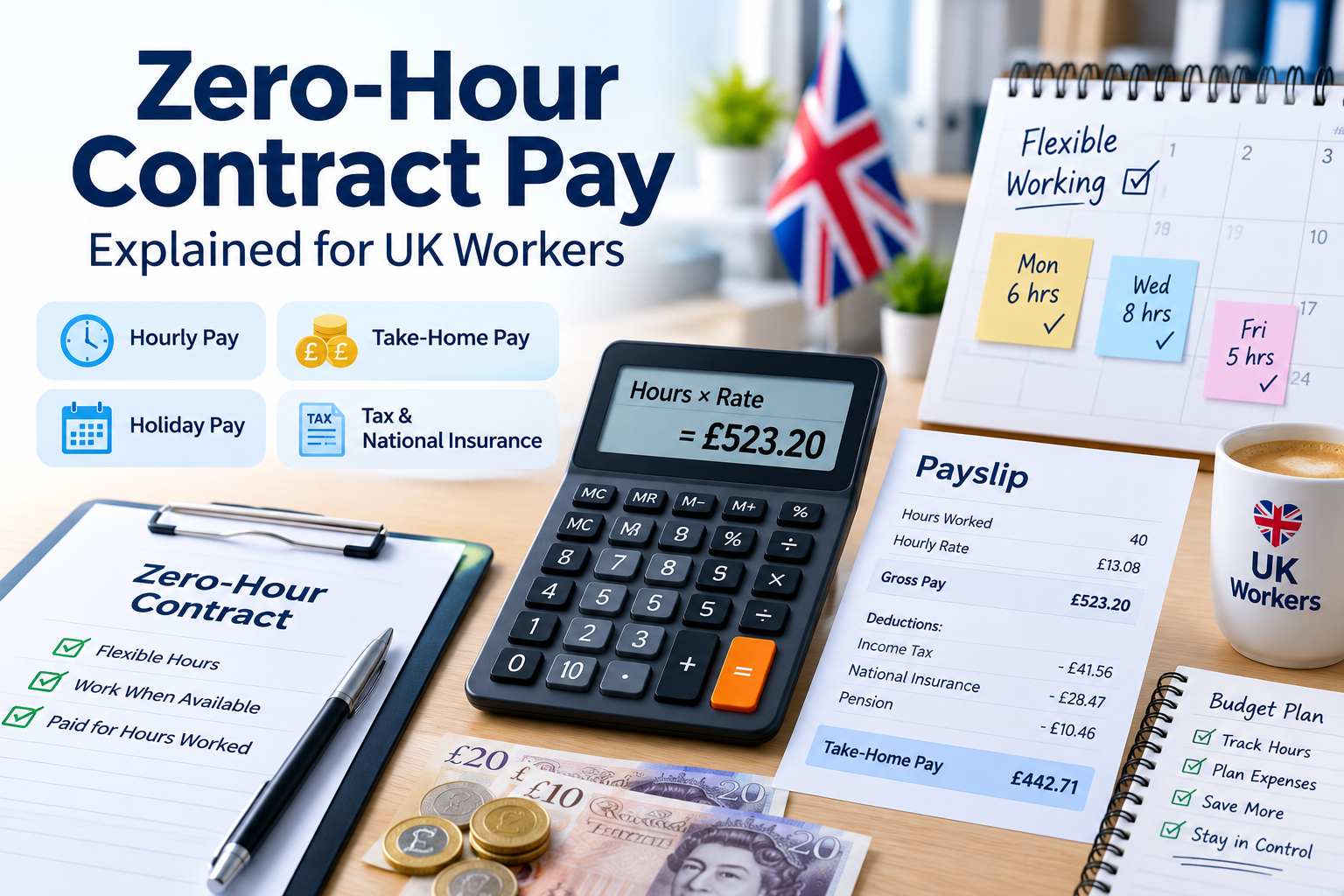
If you work on a zero-hour contract, your weekly or monthly income can change significantly depending on how many hours you work. Unlike a traditional employee with fixed contracted hours, you may not know exactly how much you will earn from one pay period to the next.
Understanding Zero-Hour Contract Pay can help you estimate your earnings, check your payslip and work out how much you could receive after tax and National Insurance.
A Rata Calculator UK can also be useful when you need to calculate pay based on the hours you actually worked rather than a fixed salary.
This guide explains how zero-hour contract pay works in the UK, how to calculate your gross earnings, what happens with holiday pay, and which deductions may reduce your take-home pay.
What Is a Zero-Hour Contract?
A zero-hour contract is an employment arrangement where the contract does not guarantee you a minimum number of working hours.
Your employer may offer work when it is available, and you can generally be paid for the hours you actually work. Depending on the contract, you may also have flexibility to accept or refuse offered work.
For example, imagine you are paid £12.50 an hour and work:
| Week | Hours Worked | Hourly Rate | Gross Pay |
|---|---|---|---|
| Week 1 | 20 | £12.50 | £250 |
| Week 2 | 12 | £12.50 | £150 |
| Week 3 | 28 | £12.50 | £350 |
| Week 4 | 16 | £12.50 | £200 |
Your total gross pay for those four weeks would be £950.
This is one reason Zero-Hour Contract Pay can be harder to budget than a fixed monthly salary.
How Does Zero-Hour Contract Pay Work?
The basic calculation is straightforward:
Gross pay = Hours worked × Hourly pay rate
If you work different numbers of hours each week, calculate each week’s pay separately and then add the amounts together.
For example, suppose your hourly rate is £13.20.
You work:
- Monday: 6 hours
- Tuesday: 7 hours
- Thursday: 5 hours
- Saturday: 8 hours
Your total hours are:
6 + 7 + 5 + 8 = 26 hours
Your gross pay is:
26 × £13.20 = £343.20
So your gross pay for that period is £343.20 before deductions.
If your employer pays weekly, this may be your gross weekly pay. If your employer pays monthly, you may have several weeks of variable hours included in the same pay period.
Visit Now: MauricetteCalculetteWhat Is Gross Pay?
Gross pay is the amount you earn before deductions.
For a zero-hour worker, gross pay can include more than your basic hourly earnings. Depending on your employment arrangement, it could include:
- Basic hourly wages
- Overtime payments
- Eligible bonuses
- Commission
- Premium payments for certain shifts
- Holiday pay
- Other taxable payments
Your payslip should normally show your gross pay and the deductions taken from it.
Gross pay is important because income tax and National Insurance calculations are generally based on your earnings, subject to the applicable rules and thresholds.
What Is Take-Home Pay?
Take-home pay is the amount that reaches your bank account after deductions.
A simple way of looking at the calculation is:
Take-home pay = Gross pay − Income Tax − National Insurance − other deductions
Other deductions could include workplace pension contributions, student loan repayments or other authorised deductions.
For example:
| Calculation | Amount |
|---|---|
| Gross pay | £1,200 |
| Income Tax | £80 |
| National Insurance | £35 |
| Pension | £24 |
| Estimated take-home pay | £1,061 |
This is only an example. Your actual deductions depend on your tax code, pay frequency, earnings, pension arrangements and other circumstances.
Read More: Pro Rata Calculator UK- Fixed-Term Contract Pay GuideHow to Calculate Zero-Hour Contract Pay
You can calculate Zero-Hour Contract Pay in a few simple steps.
Step 1: Add Up Your Hours
Start by finding the total number of hours you worked during the relevant pay period.
Suppose you worked:
- 8 hours on Monday
- 6.5 hours on Wednesday
- 7 hours on Friday
- 5 hours on Saturday
Your total is:
8 + 6.5 + 7 + 5 = 26.5 hours
Step 2: Check Your Hourly Rate
Look at your employment contract or payslip to confirm your hourly rate.
For example:
Hourly rate = £12.50
Step 3: Multiply Your Hours by Your Rate
Now calculate:
26.5 × £12.50 = £331.25
Your gross basic pay is therefore £331.25.
Step 4: Add Other Pay
If you received overtime, a bonus or another payment, add it to your basic earnings where applicable.
For example:
Basic pay: £331.25
Bonus: £30
Gross pay: £361.25
Step 5: Account for Deductions
Your employer may then deduct applicable Income Tax, National Insurance and other amounts.
The result is your estimated take-home pay.
Zero-Hour Contract Pay Example
Let’s consider a more realistic monthly example.
Sarah works under a zero-hour contract and is paid £13 per hour.
During one month, she works:
| Week | Hours |
|---|---|
| Week 1 | 18 |
| Week 2 | 24 |
| Week 3 | 15 |
| Week 4 | 22 |
Total hours:
18 + 24 + 15 + 22 = 79 hours
Gross pay:
79 × £13 = £1,027
Sarah’s gross pay for the hours worked is therefore £1,027 before any additional payments or deductions.
Her actual take-home pay could be lower after Income Tax, National Insurance, pension contributions or other deductions.
The important point is that the calculation starts with the hours actually worked and the applicable pay rate.
Read More: Pro Rata Calculator UK-Commission Pay ExplainedDoes a Zero-Hour Contract Have a Minimum Wage?
Yes. Zero-hour workers are generally entitled to at least the applicable National Minimum Wage or National Living Wage, depending on their age and circumstances.
Being employed under a zero-hour contract does not allow an employer to pay below the legal minimum simply because the employee has no guaranteed hours.
The applicable minimum rate can change, so you should check the current UK rates when calculating pay.
It is also important to consider which hours count as working time. In some circumstances, time that may not look like ordinary productive work can still need to be paid.
If you believe you have been paid below the legal minimum, keep your payslips and records of hours worked and seek appropriate employment or wage advice.
Do Zero-Hour Workers Get Holiday Pay?
Yes. Workers on zero-hour contracts can be entitled to paid statutory holiday.
Holiday entitlement and the way holiday pay is calculated depend on the worker’s circumstances and the current rules.
For irregular-hours workers and part-year workers, changes introduced for leave years beginning on or after 1 April 2024 allow employers to use a 12.07% accrual method for statutory holiday entitlement in qualifying circumstances.
This is an important area because holiday pay is not simply a matter of adding 12.07% in every situation.
For example, if a qualifying irregular-hours worker earns £1,000 in a particular pay period, 12.07% of that amount would be:
£1,000 × 12.07% = £120.70
However, this should not automatically be treated as the correct holiday entitlement or holiday pay for every zero-hour worker. The worker’s status, leave year, type of employment and employer’s holiday arrangements all matter.
Employers and workers should use the applicable government guidance when determining the correct entitlement.
What Is Rolled-Up Holiday Pay?
Rolled-up holiday pay is a system where holiday pay is paid at the same time as normal wages instead of being paid when the employee actually takes holiday.
For qualifying irregular-hours and part-year workers, employers can use rolled-up holiday pay under the rules applying to leave years beginning on or after 1 April 2024, subject to the relevant conditions.
This can make a difference when calculating Zero-Hour Contract Pay.
If your payslip includes a separate holiday pay amount, do not automatically assume that it is an error. Check your contract and the way your employer calculates holiday entitlement.
Holiday pay rules can be complicated, particularly where employment patterns change during the year.
Can Zero-Hour Workers Be Paid Weekly or Monthly?
Yes. A zero-hour worker can be paid weekly, fortnightly, monthly or according to another agreed payroll schedule.
The payment frequency does not change the basic principle:
Pay is calculated according to the hours or work covered by the relevant pay period.
For example, a worker paid weekly may receive four separate payments of:
- £280
- £350
- £190
- £410
A monthly-paid worker might receive one payment covering the hours worked during the employer’s monthly payroll period.
This means a monthly income figure for a zero-hour worker should not necessarily be treated as a fixed salary.
Read More: Rata Calculator UK – Paternity Leave PayHow Income Tax Works on Zero-Hour Contract Pay
Zero-hour workers can be taxed through PAYE, just like other employees.
Your employer normally uses your tax code and payroll information to calculate Income Tax deductions.
One common misunderstanding is that having a zero-hour contract automatically means you pay more tax. It does not.
The amount of tax you pay depends on your taxable income and applicable tax rules, rather than simply on whether your contract has guaranteed hours.
Because your earnings can fluctuate, your deductions can also vary from one pay period to another.
For example, if you work only a few hours in one month, your pay may be relatively low. If you work substantially more hours in the next month, your deductions may increase.
Your tax code also matters. If you have more than one job, your tax position can be different because your allowances and tax codes may be allocated between your employments.
National Insurance on Zero-Hour Contract Pay
National Insurance can also be deducted from employment earnings where applicable.
The amount depends on your earnings, pay frequency and the National Insurance rules that apply to you.
This means two people earning the same annual amount can potentially see different deductions depending on how their pay is structured and other circumstances.
When estimating take-home pay, it is therefore better to use the actual payroll period and relevant thresholds rather than assuming a simple percentage deduction.
Zero-Hour Contract Pay and Workplace Pensions
If you are eligible for automatic enrolment, your employer may have to enrol you into a workplace pension.
Your pension contribution can reduce the amount you receive in your bank account.
For example:
Gross pay: £1,500
Income Tax and National Insurance: £150
Pension contribution: £45
Estimated take-home pay: £1,305
The actual calculation will depend on your pension scheme and payroll arrangements.
A lower take-home amount does not necessarily mean your employer has incorrectly calculated your wages. Check the deductions listed on your payslip before raising a query.
Can You Refuse Work on a Zero-Hour Contract?
The answer depends on the terms of your contract and the nature of the working relationship.
A zero-hour contract generally does not guarantee a minimum number of hours. However, you should not assume that every zero-hour contract has exactly the same terms.
Read your written contract carefully to understand:
- Whether you are required to accept work
- Whether the employer can require you to work at particular times
- Whether there are exclusivity provisions
- How shifts are offered
- How much notice is normally provided
- What happens if a shift is cancelled
- How holiday is handled
- How and when you are paid
Employment rights can depend on whether you are legally classed as an employee or worker, so contract terminology alone is not always enough.
How to Budget With Zero-Hour Contract Pay
Variable income makes budgeting more difficult, but a few practical techniques can help.
Use Your Lowest Reliable Income
Instead of building your monthly budget around your best month, look at your recent earnings and use a conservative figure.
For example, if your monthly gross earnings have been:
- £900
- £1,150
- £980
- £1,300
- £1,050
It may be safer to build your essential budget around a lower amount rather than assuming you will earn £1,300 every month.
Read more: Pro Rata Calculator UK – Maternity PaySeparate Essential and Flexible Spending
Essential expenses may include:
- Rent or mortgage
- Council Tax
- Energy bills
- Food
- Transport
- Insurance
- Debt repayments
Flexible expenses might include entertainment, eating out and non-essential shopping.
When your income falls, having a clear distinction between these categories makes it easier to adjust spending.
Keep an Income Buffer
If your income changes from month to month, building an emergency fund can make a significant difference.
Even a small reserve can help cover essential expenses during a period when fewer shifts are available.
Using a Rata Calculator UK for Zero-Hour Earnings
A Rata Calculator UK can help you estimate earnings when your income is based on hours rather than a fixed annual salary.
For a basic zero-hour calculation, you need:
- Total hours worked
- Hourly pay rate
- Any additional earnings
- Pay frequency
- Relevant tax and payroll information if you want to estimate take-home pay
For example:
Hours worked: 72
Hourly rate: £13.50
Gross pay = 72 × £13.50 = £972
You can then use the gross amount as the starting point for estimating deductions.
A calculator can provide a useful estimate, but it should not replace your payslip or official payroll calculation. Tax codes, pension arrangements, multiple jobs and other circumstances can change the final amount.
Common Mistakes When Calculating Zero-Hour Pay
Mistake 1: Using Contracted Hours
A zero-hour contract may not provide fixed weekly hours. Do not calculate earnings using an assumed number of hours unless your employment arrangement actually guarantees those hours.
Mistake 2: Ignoring Holiday Pay
Holiday entitlement is an important part of employment income. Check whether holiday pay is paid separately, when leave is taken, or through a permitted rolled-up arrangement.
Mistake 3: Assuming Gross Pay Equals Take-Home Pay
Your bank payment can be lower than your gross wages because of Income Tax, National Insurance, pension contributions and other deductions.
Mistake 4: Using the Wrong Hourly Rate
Check whether your rate has changed because of a new legal minimum wage rate, pay rise or different rate for certain types of work.
Mistake 5: Forgetting Extra Hours
Keep your own record of shifts and hours worked. This is particularly useful when your working pattern changes frequently.
What Should Be Shown on Your Payslip?
A payslip should give you enough information to understand how your pay was calculated.
Depending on your circumstances, it may show:
- Gross pay
- Net pay
- Basic pay
- Hours or rates where applicable
- Income Tax
- National Insurance
- Pension contributions
- Other deductions
If your hours vary significantly, keeping your own records can help you compare the hours you worked with the amount shown on your payslip.
If something does not look right, ask your employer’s payroll or HR department for an explanation.
Zero-Hour Contract Pay vs Fixed Salary
The biggest difference between zero-hour pay and a fixed salary is predictability.
| Feature | Zero-Hour Contract | Fixed-Hour Salary |
|---|---|---|
| Guaranteed hours | Usually none | Usually specified |
| Income predictability | Lower | Higher |
| Pay calculation | Often based on hours worked | Usually based on annual salary |
| Monthly earnings | Can change | Generally more consistent |
| Holiday entitlement | Can apply | Can apply |
| PAYE tax | May apply | May apply |
| National Insurance | May apply | May apply |
This does not mean zero-hour work is always better or worse. The right arrangement depends on the worker’s circumstances, flexibility requirements and financial needs.
Is zero-hour contract pay taxed?
Yes. If you earn enough to be taxable, your employment income can be subject to Income Tax through PAYE. Your tax code and total taxable earnings determine the amount deducted.
Do zero-hour workers pay National Insurance?
They can. National Insurance deductions depend on earnings and the applicable rules and thresholds.
Do I get paid if my employer offers no hours?
A zero-hour contract generally does not guarantee a minimum amount of work or pay. However, your specific contractual rights and employment status matter.
Can I claim holiday pay on a zero-hour contract?
Yes. Zero-hour workers can be entitled to statutory paid holiday. The calculation method depends on the worker’s circumstances and the applicable rules.
Is 12.07% holiday pay always correct for zero-hour workers?
No. The 12.07% method applies in qualifying circumstances under the rules for relevant irregular-hours and part-year workers. It should not automatically be applied to every zero-hour worker.
How do I calculate my weekly zero-hour pay?
Multiply the number of hours you worked by your applicable hourly rate. Then add any relevant additional payments and account for deductions to estimate your take-home pay.
Can my zero-hour income change every month?
Yes. If your hours vary, your gross pay can increase or decrease depending on how much work you complete during each payroll period.
Final Thoughts on Zero-Hour Contract Pay
Zero-Hour Contract Pay is mainly determined by the work you actually perform, your applicable pay rate and the payroll period used by your employer. Unlike a fixed salary, your income can change considerably from week to week or month to month.
The easiest starting point is:
Hours worked × hourly rate = gross basic pay
From there, consider holiday pay, overtime or other payments, followed by Income Tax, National Insurance, pension contributions and other deductions.
If you use a Rata Calculator UK, treat the result as an estimate rather than a replacement for your employer’s payroll calculation. For the most accurate result, use the hours and pay rate shown on your contract and payslip and make sure you understand how your holiday pay and deductions are being handled.
For workers with irregular income, keeping accurate records and budgeting around a conservative income figure can make it much easier to manage the uncertainty that comes with zero-hour employment.