
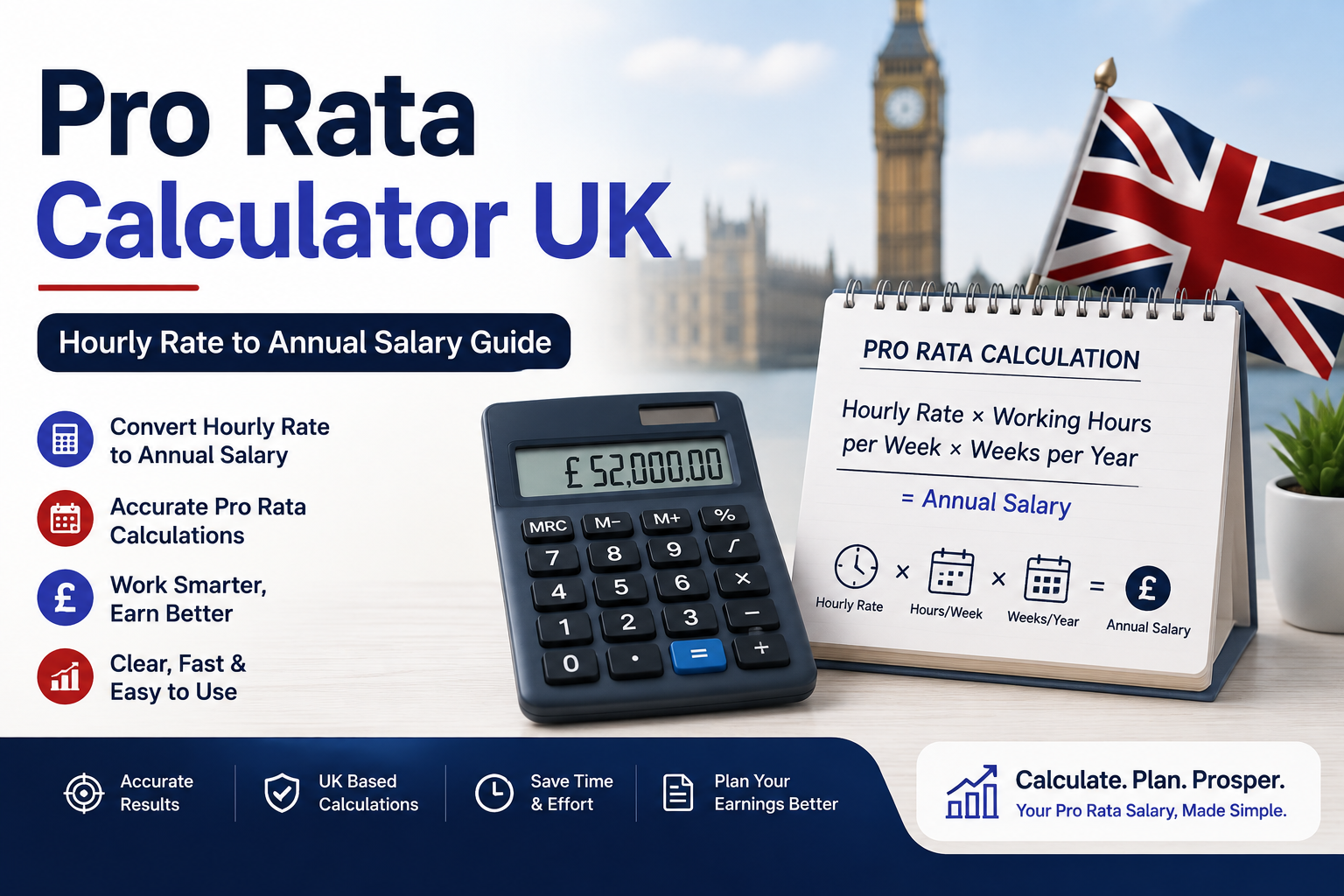
If you know your hourly pay but need to work out your annual salary, the calculation is usually straightforward. You multiply your hourly rate to annual salary by the number of hours you work each week and the number of weeks you are paid each year.
For example, someone earning £15 an hour and working 37.5 hours a week for 52 weeks would have a gross annual salary of £29,250.
However, the simple calculation does not always tell the whole story. Your actual annual earnings can change if you work part-time, have unpaid weeks, receive overtime, work term-time only, or have a contract where holiday pay is handled separately.
This guide explains how to convert an hourly rate into an annual salary in the UK, including the formula, practical examples, pro rata calculations and common mistakes to avoid.
How to Convert an Hourly Rate to Annual Salary
The basic formula is:
Annual salary = Hourly rate × Hours worked per week × Weeks worked per year
If you are paid for 52 weeks of the year, the calculation becomes:
Annual salary = Hourly rate × Weekly hours × 52
Example: £15 per hour
Suppose you earn £15 per hour and work 37.5 hours every week.
- Hourly rate: £15
- Weekly hours: 37.5
- Weeks per year: 52
First calculate your weekly pay:
£15 × 37.5 = £562.50
Then calculate annual pay:
£562.50 × 52 = £29,250
Your gross annual salary is therefore £29,250.
This is your pay before Income Tax, National Insurance, pension contributions or other deductions.
Visit Now: Mauricette CalculetteHourly Rate to Annual Salary Formula UK
For most standard employment arrangements, you can use:
Hourly rate × hours per week × 52 = annual salary
Here are some examples:
| Hourly Rate | Weekly Hours | Annual Salary |
|---|---|---|
| £10 | 20 | £10,400 |
| £12 | 20 | £12,480 |
| £15 | 20 | £15,600 |
| £15 | 30 | £23,400 |
| £15 | 37.5 | £29,250 |
| £18 | 37.5 | £35,100 |
| £20 | 37.5 | £39,000 |
| £25 | 40 | £52,000 |
| £30 | 40 | £62,400 |
These figures assume 52 paid weeks and consistent working hours throughout the year.
If your employment contract uses a different number of paid weeks, use that number instead of 52.
Why the Number of Working Hours Matters
An hourly rate by itself does not tell you your annual earnings. You also need to know how many hours you work.
Someone earning £15 an hour could have very different annual earnings depending on their schedule.
For example:
- 20 hours per week: £15 × 20 × 52 = £15,600
- 30 hours per week: £15 × 30 × 52 = £23,400
- 37.5 hours per week: £15 × 37.5 × 52 = £29,250
- 40 hours per week: £15 × 40 × 52 = £31,200
This is why comparing jobs using the hourly rate alone can sometimes be misleading.
A job paying £18 per hour may appear better than one paying £16 per hour, but the second job could offer substantially more guaranteed hours or additional benefits.
How to Calculate Annual Salary From Monthly Hours
Sometimes your contract or timesheet gives you an average number of hours per month rather than weekly hours.
A useful annual calculation is:
Annual salary = Hourly rate × Annual hours
For example, if you earn £18 per hour and work 1,950 hours per year:
£18 × 1,950 = £35,100
Your gross annual earnings would be £35,100.
You can also calculate annual hours from a regular weekly schedule:
Weekly hours × 52 = annual hours
For someone working 37.5 hours a week:
37.5 × 52 = 1,950 hours
So:
£18 × 1,950 = £35,100
This approach is particularly useful when comparing an hourly-paid position with a salaried position.
Read More: Rata Calculator UK- Daily Rate to Pro Rata SalaryWhat Is a Pro Rata Salary?
A pro rata salary is a salary adjusted to reflect reduced working hours or a shorter working arrangement compared with a full-time equivalent role.
This is especially common for part-time employees.
For example, imagine a full-time job pays £36,000 for 40 hours per week. If you work 20 hours per week under otherwise equivalent conditions, your pro rata salary could be:
£36,000 × (20 ÷ 40) = £18,000
You would receive 50% of the full-time salary because you work 50% of the full-time hours.
However, pro rata calculations can vary depending on the contract. Employers may use annual hours, working days, weeks or another agreed method.
Hourly Rate to Pro Rata Annual Salary
If you already know your hourly rate, you do not necessarily need a full-time salary to calculate your annual earnings.
Use:
Hourly rate × contracted weekly hours × paid weeks = annual gross pay
For example, you earn £16.50 per hour and work 25 hours per week for 52 paid weeks:
£16.50 × 25 × 52 = £21,450
Your estimated gross annual salary is £21,450.
If you only work for 40 paid weeks of the year:
£16.50 × 25 × 40 = £16,500
The difference is important. The same hourly rate and weekly hours can produce different annual earnings depending on how many weeks are paid.
Hourly Rate to Annual Salary for Part-Time Workers
Part-time workers can use the same basic formula, but they should pay particular attention to contracted hours.
Suppose you work three days per week, eight hours per day, and earn £14.50 per hour.
Your weekly hours are:
3 × 8 = 24 hours
Your annual pay, assuming 52 paid weeks, is:
£14.50 × 24 × 52 = £18,096
Your gross annual salary would therefore be £18,096.
If your working pattern changes during the year, you may need to calculate each period separately.
For example, if you work 20 hours a week for part of the year and 30 hours a week later, calculate the earnings for each period and add them together.
Read More: Pro Rata Calculator UK- Weekly Pay CalculationHow to Calculate Annual Salary for Different Weekly Hours
Your annual salary changes directly with your weekly working hours.
Consider an hourly rate of £17:
| Weekly Hours | Weekly Pay | Annual Pay at 52 Weeks |
|---|---|---|
| 16 | £272 | £14,144 |
| 20 | £340 | £17,680 |
| 25 | £425 | £22,100 |
| 30 | £510 | £26,520 |
| 35 | £595 | £30,940 |
| 37.5 | £637.50 | £33,150 |
| 40 | £680 | £35,360 |
This table can help when comparing part-time and full-time roles.
Remember that these are gross figures. Your actual take-home pay will normally be lower after applicable deductions.
What Does £20 an Hour Equal as an Annual Salary?
At £20 per hour, the annual salary depends on your working hours.
£20 per hour at 20 hours a week
£20 × 20 × 52 = £20,800
£20 per hour at 30 hours a week
£20 × 30 × 52 = £31,200
£20 per hour at 37.5 hours a week
£20 × 37.5 × 52 = £39,000
£20 per hour at 40 hours a week
£20 × 40 × 52 = £41,600
So there is no single annual salary for a £20 hourly rate. Your working pattern determines the result.
What Does £15 an Hour Equal as an Annual Salary?
At £15 per hour:
| Weekly Hours | Annual Salary |
|---|---|
| 20 | £15,600 |
| 25 | £19,500 |
| 30 | £23,400 |
| 35 | £27,300 |
| 37.5 | £29,250 |
| 40 | £31,200 |
These calculations assume 52 paid weeks.
If you receive paid annual leave as part of your employment arrangement, you should not normally subtract your statutory paid holiday weeks from the 52-week calculation simply because you are not physically working during those weeks. Whether holiday is already reflected in an hourly rate depends on the employment arrangement and how pay is calculated.
What Does £25 an Hour Equal as an Annual Salary?
At £25 per hour:
20 hours per week: £25 × 20 × 52 = £26,000
30 hours per week: £25 × 30 × 52 = £39,000
37.5 hours per week: £25 × 37.5 × 52 = £48,750
40 hours per week: £25 × 40 × 52 = £52,000
This illustrates why an hourly rate should always be considered alongside guaranteed hours.
How to Calculate Annual Salary From an Hourly Rate With Unpaid Weeks
Some workers do not receive pay for every week of the year.
This can happen with certain temporary, seasonal or term-time working arrangements.
If you have unpaid weeks, use the number of paid weeks rather than automatically using 52.
For example:
- Hourly rate: £18
- Weekly hours: 30
- Paid weeks: 45
Calculation:
£18 × 30 × 45 = £24,300
Estimated annual gross pay: £24,300
This method is more accurate than multiplying by 52 when seven weeks are genuinely unpaid.
However, employment contracts can treat annual salary and holiday pay differently, so check your contract before assuming that all non-working weeks are unpaid.
Term-Time Only Workers
Term-time employment requires particular care.
A term-time worker may work only during school or college terms but can have a salary that is spread across the entire year.
For example, an employee might work during term time but receive equal monthly payments throughout the year.
In this situation, simply multiplying the hourly rate by term-time weeks may not reproduce the salary shown on the employment contract.
You should look at:
- Contracted hours
- Number of working weeks
- Paid holiday entitlement
- Whether holiday is included or paid separately
- Whether salary is spread over 12 months
- Any unpaid periods
A pro rata calculator can provide an estimate, but the employer’s contractual calculation should be treated as the definitive figure.
Read More: Rata Calculator UK – Weekend Workers ProAnnual Salary vs Gross Annual Pay
These terms are related but are not always interchangeable.
Gross annual pay generally means the amount you earn before deductions.
Annual salary usually refers to the fixed salary stated in an employment contract.
An hourly-paid employee may not have a fixed annual salary. Their annual earnings can depend on the number of hours actually worked.
For example, an employee paid £16 an hour with variable hours might earn:
- £2,000 in one month
- £2,400 in another month
- £1,800 in a quieter month
Their annual earnings will depend on the total hours worked.
A salaried employee, by contrast, may receive a fixed annual amount regardless of small changes in their weekly working pattern, subject to the terms of their contract.
Does Annual Salary Include Overtime?
Usually, the basic hourly-to-annual calculation does not include overtime unless you specifically add it.
Suppose you earn £18 per hour and work 40 regular hours per week:
£18 × 40 × 52 = £37,440
If you also work five hours of overtime every week at £27 per hour:
£27 × 5 × 52 = £7,020
Your combined gross earnings would be:
£37,440 + £7,020 = £44,460
Overtime rates vary by employer and contract. There is no universal rule requiring all UK workers to receive a particular overtime premium.
How to Work Backwards From Annual Salary to Hourly Rate
You can also reverse the calculation.
The formula is:
Hourly rate = Annual salary ÷ (Weekly hours × Paid weeks)
For example, suppose a job advert offers £31,200 per year for 40 hours per week.
Annual hours:
40 × 52 = 2,080
Hourly equivalent:
£31,200 ÷ 2,080 = £15 per hour
So the salary is equivalent to £15 an hour, assuming 52 paid weeks.
This calculation is useful when comparing a salaried job with an hourly-paid position.
How to Compare an Hourly Job With a Salaried Job
When comparing two jobs, do not look at the headline pay figure alone.
Consider:
- Hourly rate
- Contracted weekly hours
- Guaranteed hours
- Paid holiday
- Overtime arrangements
- Pension contributions
- Bonuses
- Unpaid working periods
- Travel or other work-related costs
- Expected annual earnings
For example, a £35,000 salaried job and a £20 hourly job cannot be compared properly without knowing the working hours.
At 37.5 hours per week for 52 weeks, £20 per hour is equivalent to:
£20 × 37.5 × 52 = £39,000
At 35 hours per week:
£20 × 35 × 52 = £36,400
The effective annual value changes with the working pattern.
Using a Pro Rata Calculator UK
A Pro Rata Calculator UK can make these calculations faster, particularly when you are comparing part-time and full-time salaries.
For an hourly-to-annual calculation, enter:
- Your hourly rate
- Your weekly working hours
- The number of paid weeks per year
The calculator can then estimate your gross annual earnings.
For a salary-based pro rata calculation, you may instead need:
- Full-time annual salary
- Full-time weekly hours
- Your actual weekly hours
The calculation is generally:
Full-time salary × (Your hours ÷ Full-time hours)
For example:
£40,000 × (30 ÷ 40) = £30,000
This gives a pro rata annual salary of £30,000.
Read More: Pro Rata Calculator UK- Civil Service SalaryImportant UK Pay Considerations
An hourly rate to annual salary calculation is an estimate of gross earnings. It does not calculate your take-home pay.
Your net income can be affected by:
- Income Tax
- Employee National Insurance
- Workplace pension contributions
- Student loan repayments
- Salary sacrifice arrangements
- Other payroll deductions
Your tax position can also depend on factors such as your total income, tax code and where you live in the UK.
For this reason, an annual salary figure should not be treated as the amount that will reach your bank account.
Minimum Wage Considerations
If you are checking whether an hourly rate is legally compliant, use the applicable UK National Minimum Wage or National Living Wage rate for the worker’s age and circumstances.
Do not assume that converting a salary into an hourly figure automatically proves that a job meets minimum wage requirements. The legal calculation can involve specific rules about working time, deductions and the type of work being performed.
Common Mistakes When Converting Hourly Pay to Annual Salary
Using 52 weeks when some weeks are genuinely unpaid
If your contract has unpaid weeks, using 52 can overstate your expected annual earnings.
Forgetting your actual weekly hours
£18 an hour at 20 hours a week is very different from £18 an hour at 40 hours a week.
Treating overtime as guaranteed income
Regular overtime may increase your earnings, but unless it is contractually guaranteed, it may not be appropriate to include it in your basic annual salary estimate.
Confusing gross pay with take-home pay
The hourly-to-annual formula produces gross earnings. It does not account for payroll deductions.
Ignoring holiday arrangements
Paid holiday and unpaid leave can affect how an hourly rate should be interpreted. Check whether holiday pay is included within your employment arrangement.
Assuming every full-time job uses 40 hours
A standard working week varies between employers. Many UK jobs use 35, 37, 37.5 or 40 hours, among other arrangements.
Always use the actual contracted hours when making your calculation.
Expert Tips for Comparing Pay
Use annual hours when possible. If your contract states your expected annual hours, multiplying those hours by your hourly rate can give a more direct estimate.
Separate guaranteed and variable earnings. Keep basic pay, overtime, bonuses and commission separate when comparing employment offers.
Check whether holidays are paid. Two jobs with the same hourly rate may have different annual values depending on the contractual arrangements.
Compare like for like. Use the same weekly hours and paid weeks when comparing two hourly rates.
Check the contract. A calculator provides an estimate, while your employment contract determines your actual pay arrangements.
How do I calculate hourly rate to annual salary?
Multiply your hourly rate by your weekly working hours and the number of paid weeks per year.
Formula: Hourly rate × weekly hours × paid weeks = annual salary.
For 52 paid weeks, multiply the hourly rate by weekly hours and then by 52.
How much is £15 an hour per year in the UK?
At 40 hours per week and 52 paid weeks, £15 an hour equals £31,200 per year before deductions.
At 37.5 hours per week, it equals £29,250.
How much is £20 an hour per year?
At 40 hours per week for 52 paid weeks, £20 an hour equals £41,600 per year.
At 37.5 hours per week, it equals £39,000.
How much is £25 an hour per year?
At 40 hours per week and 52 paid weeks, £25 an hour equals £52,000 per year.
How do I calculate pro rata salary from full-time salary?
Divide your actual weekly hours by the full-time weekly hours, then multiply the result by the full-time salary.
For example, £36,000 at 40 hours full-time and 20 hours part-time:
£36,000 × (20 ÷ 40) = £18,000
Does hourly pay include holiday pay?
It depends on the employment arrangement and how the employer calculates and pays holiday entitlement. Do not automatically assume that holiday pay is included in the advertised hourly rate. Check your contract or payslip.
Is hourly rate the same as annual salary?
No. An hourly rate is the amount paid for each hour worked, while an annual salary is a yearly amount. You can convert one into the other when you know the working hours and paid weeks.
Can I include overtime in my annual salary calculation?
Yes, if you want to estimate total annual earnings, but calculate overtime separately from your basic pay. This makes it easier to see how much income is guaranteed and how much depends on additional hours.
Final Takeaway
Converting an hourly rate to annual salary is usually simple:
Hourly rate × weekly hours × paid weeks = annual gross pay
For a standard 52-week arrangement, an hourly rate of £20 at 40 hours per week works out to £41,600 a year, while £20 at 30 hours per week works out to £31,200.
The key is to use your actual contracted hours and paid weeks rather than relying on a standard full-time schedule.
For part-time, term-time or variable-hour work, pay arrangements can be more complicated. Holiday pay, unpaid weeks, overtime and annualised salaries can all affect the final figure. Use your employment contract alongside a Pro Rata Calculator UK to get the most useful estimate and always treat the calculator result as gross pay before deductions.