
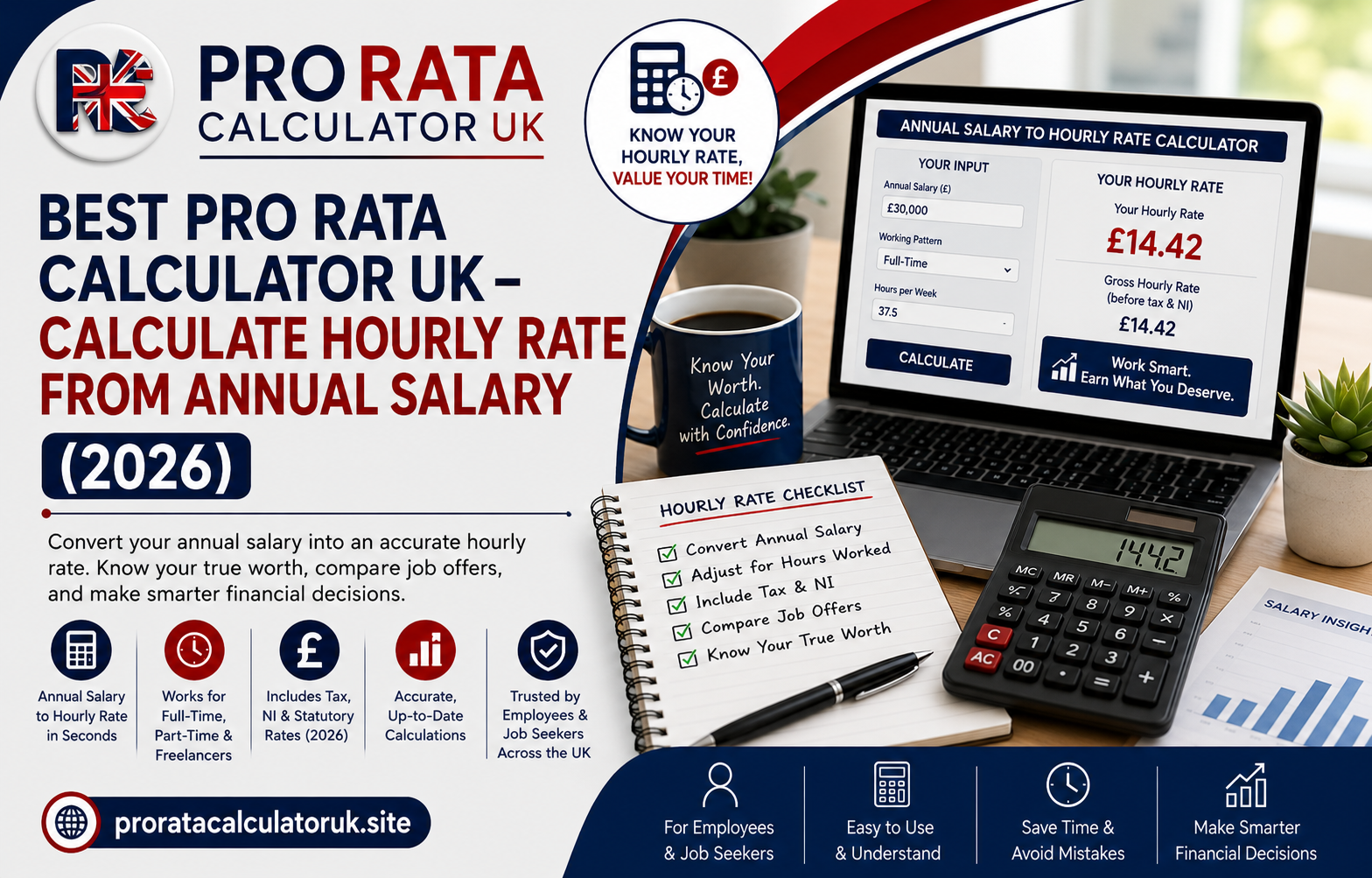
Most UK job adverts, contracts, and payslips quote an annual salary, but very few day-to-day decisions actually work in annual terms. Whether you’re comparing two job offers, working out if a freelance day rate is worth it, or checking if you’re being paid at least the National Minimum Wage, you need to know your actual hourly rate — not just the headline yearly figure.
A Pro Rata Calculator UK tool converts an annual salary into an hourly rate quickly, but understanding the maths behind it means you can trust the number and adjust it correctly for your own working pattern. This guide covers the standard formula, how holiday pay affects the calculation, and how the method changes for part-time staff, freelancers, and irregular hours.
Why You Need to Know Your Hourly Rate
An annual salary on its own doesn’t tell you much about value for time. Two jobs paying the same £30,000 salary can represent very different hourly rates depending on how many hours you’re actually contracted to work.
Knowing your hourly rate helps you:
- Compare job offers accurately, especially when contracted hours differ between roles.
- Check you’re being paid at least the National Minimum Wage or National Living Wage, which are set as hourly figures.
- Work out fair pay for overtime, freelance projects, or side work, using a consistent baseline.
- Spot payslip errors, since a wrong hourly rate often points to an incorrect FTE salary or hours figure somewhere upstream.
The Standard Formula for Hourly Rate From Salary
The most common method used across UK payroll and HR systems is:
Hourly Rate = Annual Salary ÷ (Weekly Hours × 52)
Example: A salary of £30,000, based on a standard 37.5-hour week:
£30,000 ÷ (37.5 × 52) = £30,000 ÷ 1,950 = £15.38/hour
This is the most widely used approach because it treats the year as a full 52 weeks, which is simple and consistent — though it’s worth noting this method technically includes paid holiday weeks within the total, since you’re still being paid during time off.
Read More: Best Pro Rata Calculator UK-How to Calculate Salary for 4 Days a WeekAdjusting for a Different Weekly Hours Figure
Not every full-time role uses 37.5 hours. Some are based on 35 hours, 40 hours, or other figures entirely, so always use your actual contracted hours rather than assuming a default.
Example: A £28,000 salary based on a 40-hour week:
£28,000 ÷ (40 × 52) = £28,000 ÷ 2,080 = £13.46/hour
Compare this to the same £28,000 salary on a 35-hour week:
£28,000 ÷ (35 × 52) = £28,000 ÷ 1,820 = £15.38/hour
The same annual salary produces a noticeably different hourly rate depending on contracted hours, which is exactly why comparing salaries alone can be misleading.
Table: Hourly Rate at Common UK Salaries (37.5-Hour Week)
| Annual Salary | Approx. Hourly Rate |
|---|---|
| £22,000 | £11.28 |
| £25,000 | £12.82 |
| £28,000 | £14.36 |
| £30,000 | £15.38 |
| £35,000 | £17.95 |
| £40,000 | £20.51 |
These figures are based on a 37.5-hour week across 52 weeks a year, before tax and National Insurance deductions.
Should You Use 52 Weeks or Actual Working Weeks?
This is where a lot of online calculators oversimplify the maths. There are two slightly different methods, and both are valid depending on what you’re trying to work out.
Method 1: Including Paid Holiday (52 Weeks)
This treats your salary as being spread evenly across the whole year, including the weeks you’re on paid annual leave. It’s the standard method for comparing salaried employment, since your pay doesn’t actually stop during holiday.
Hourly Rate = Annual Salary ÷ (Weekly Hours × 52)
Read More: Pro Rata Calculator UK-Best Bank Holiday EntitlementMethod 2: Based on Actual Working Weeks Only
This method removes paid holiday weeks from the total, giving you the rate for the hours you’re actually at work — useful when comparing to freelance or contract day rates, where you don’t get paid holiday at all.
Working Weeks = 52 − (Holiday Weeks)
Example: With 28 days (5.6 weeks) of statutory holiday:
Working Weeks = 52 − 5.6 = 46.4 weeks
Hourly Rate = Annual Salary ÷ (Weekly Hours × Working Weeks)
Using the same £30,000 salary on a 37.5-hour week:
£30,000 ÷ (37.5 × 46.4) = £30,000 ÷ 1,740 = £17.24/hour
This is a meaningfully higher figure than the 52-week method, because it reflects the rate for hours actually worked. If you’re comparing an employed salary to a freelance day rate, this second method is usually the fairer comparison.
Converting Hourly Rate to a Freelance Day Rate
If you’re moving from employment to freelance or contract work, converting your hourly rate into a day rate needs a bit more than a simple multiplication, since freelancers don’t get paid holiday, sick pay, or pension contributions.
Basic conversion:
Day Rate = Hourly Rate × Hours Per Day
Example: £17.24/hour × 7.5 hours = £129.30/day
Adjusted for lost benefits: Many freelancers add 15–25% on top of their equivalent employed rate to cover the loss of holiday pay, sick pay, pension contributions, and the extra admin (invoicing, accounting, gaps between contracts) that comes with self-employment.
£129.30 × 1.20 (20% uplift) = £155.16/day
This isn’t an exact science, but it’s a widely used starting point for freelancers pricing their first contracts based on a previous salary.
Read More: Rata Calculator UK-5 Easy Steps to CalculateHow Tax Affects Your Real Hourly Rate
The hourly rate calculated from your salary is always a gross figure — before Income Tax, National Insurance, and any pension deductions. Your actual take-home hourly rate is lower.
- Personal Allowance (2025/26): £12,570 tax-free.
- Basic rate: 20% between £12,570 and £50,270.
- Higher rate: 40% above £50,270.
- National Insurance: Charged above the relevant threshold, on top of Income Tax.
Example: On a gross hourly rate of £15.38 (from a £30,000 salary), after tax and NI, your net hourly rate typically works out closer to £12.50–£13/hour, depending on your tax code and any pension contributions.
This is worth keeping in mind whenever you see an hourly rate quoted online — always check whether it’s gross or net, since the difference is significant.
Calculating Overtime Rate From Your Hourly Rate
Once you know your base hourly rate, working out overtime pay is straightforward — but the multiplier depends entirely on your contract.
- Confirm your base hourly rate using the formula above.
- Check your contract for any overtime premium — UK law doesn’t require a premium rate, so this is contractual, not automatic.
- Multiply your hourly rate by the agreed overtime factor.
Example: Base rate £15.38/hour, contract specifies time-and-a-half for overtime:
£15.38 × 1.5 = £23.07/hour for overtime worked
If your contract doesn’t specify a premium, overtime is often paid at your standard hourly rate, though your average pay across all hours must still meet the National Minimum Wage or National Living Wage.
Visit Now: MauricetteCalculetteStep-by-Step: Calculating Your Hourly Rate From Salary
- Find your exact annual salary — use your actual contracted figure, not a rounded estimate.
- Confirm your contracted weekly hours — check your contract, since assuming a default figure (like 37.5 hours) can give an inaccurate result.
- Decide whether to include holiday weeks — use 52 weeks for a standard comparison, or 46.4 working weeks if comparing to freelance or contract rates.
- Apply the formula: Annual Salary ÷ (Weekly Hours × Number of Weeks).
- Adjust for tax if you want your net hourly rate, using your current tax code and NI thresholds.
- Cross-check against similar roles or National Minimum Wage rates to confirm the figure looks reasonable.
Calculating Hourly Rate When Bonuses or Commission Are Involved
Base salary is only part of the picture for many UK roles, especially in sales, hospitality, and some professional services jobs where bonuses or commission make up a meaningful chunk of total pay. If you’re comparing offers or checking your effective hourly rate, it’s worth separating guaranteed pay from variable pay.
- Use only your guaranteed base salary for a reliable, comparable hourly rate — bonuses and commission aren’t guaranteed and shouldn’t be treated as certain income.
- Calculate a separate “total earnings” hourly rate using your actual annual pay including bonuses, but label it clearly as a variable figure rather than your baseline rate.
- Check whether commission is capped or uncapped, since this significantly affects how reliable a total earnings hourly rate actually is year to year.
Example: A base salary of £24,000 (37.5-hour week) gives a guaranteed hourly rate of £12.31. If last year’s commission added £6,000, your total earnings hourly rate would be:
£30,000 ÷ (37.5 × 52) = £15.38/hour
Both figures are useful, but only the first one is safe to rely on when budgeting or comparing job security between offers.
Annualised Hours and Zero-Hours Contracts
Not everyone works a consistent weekly hours pattern, which makes a simple hourly rate calculation trickier. Two common arrangements need a slightly different approach.
Annualised Hours Contracts
Some roles (common in manufacturing, logistics, and education) specify total annual hours rather than a fixed weekly figure, since workload varies seasonally.
Hourly Rate = Annual Salary ÷ Total Annualised Hours
Example: A salary of £26,000 with a contract specifying 1,800 annual hours:
£26,000 ÷ 1,800 = £14.44/hour
This method sidesteps the need to estimate weekly hours entirely, since the contract already defines the annual total.
Zero-Hours and Casual Work
For zero-hours contracts, there’s no fixed annual salary to divide, so the calculation works in the opposite direction — you already know your hourly rate (it should be stated in your contract), and you can use it to estimate annual earnings based on typical hours worked.
Estimated Annual Earnings = Hourly Rate × Average Weekly Hours × 52
Example: £12/hour, averaging 20 hours a week:
£12 × 20 × 52 = £12,480 estimated annual earnings
This is useful for budgeting purposes, but keep in mind it’s an estimate only — zero-hours pay fluctuates by definition, and your actual earnings will vary depending on how many hours you’re offered each week.
How Pension Contributions Affect Your Real Hourly Rate
Auto-enrolment pension contributions come out before you see your take-home pay, so your real spending-power hourly rate is lower than even your after-tax figure suggests — though it’s worth remembering this money isn’t lost; it’s going into your own retirement savings.
- Standard minimum contributions: Under UK auto-enrolment rules, a minimum combined contribution of 8% applies to qualifying earnings (employee and employer combined), with at least 3% typically coming from the employer.
- Salary sacrifice schemes: Some employers use salary sacrifice, where your pension contribution is deducted before tax and NI are calculated, which can slightly increase your net hourly rate compared to a standard contribution setup.
- Opting out: You can opt out of auto-enrolment, which increases your take-home hourly rate immediately, though it obviously means no pension is being built for that period.
Example: On a £15.38 gross hourly rate, after tax, NI, and a 5% employee pension contribution, your effective take-home hourly rate might land closer to £12/hour — a useful figure to keep in mind when comparing your payslip to any hourly rate calculation.
Common Mistakes When Calculating Hourly Rate
- Assuming a standard 37.5-hour week for every role. Always check your actual contracted hours, since this varies significantly between employers and sectors.
- Mixing up gross and net hourly rates. The salary-based formula always gives a gross figure — tax and NI still need to be deducted separately.
- Using 52 weeks when comparing to freelance rates. This understates your real working rate, since freelancers don’t get paid holiday weeks.
- Forgetting overtime isn’t automatic. A premium rate for extra hours depends on your contract, not a legal default.
- Ignoring pension contributions. These reduce your take-home hourly rate further, on top of tax and NI.
Employed vs Freelance Hourly Rate: Quick Comparison
| Employed (Salaried) | Freelance/Contract | |
|---|---|---|
| Paid holiday | Yes, included in salary | No, must be self-funded |
| Sick pay | Statutory minimum applies | No, unless separately arranged |
| Pension contributions | Employer + employee | Self-funded entirely |
| Typical rate calculation | 52-week method | 46.4-week method plus uplift |
| Tax handling | PAYE, deducted automatically | Self-Assessment, paid separately |
1. How do I calculate my hourly rate from an annual salary?
Divide your annual salary by your weekly contracted hours multiplied by 52 (or 46.4 if excluding paid holiday weeks).
2. Should I use 52 weeks or 46.4 weeks to calculate hourly rate?
Use 52 weeks for a standard employed comparison. Use 46.4 weeks if you’re comparing your rate to freelance or contract work, since it reflects actual working weeks only.
3. Is the hourly rate from this formula gross or net?
It’s a gross figure, before Income Tax, National Insurance, and pension deductions are applied.
4. How do I convert my salary-based hourly rate into a freelance day rate?
Multiply your hourly rate by your hours per day, then add roughly 15–25% to cover lost holiday pay, sick pay, and pension contributions.
5. Does my hourly rate change if I work part-time?
No. Your hourly rate should stay the same as a full-time equivalent employee doing the same role — only your total hours and pay change.
6. How do I calculate overtime pay from my hourly rate?
Multiply your base hourly rate by any premium specified in your contract, such as time-and-a-half or double time.
7. Is my employer required to pay a higher rate for overtime?
No. Overtime premiums are contractual in the UK, not a legal requirement, though your average pay must still meet minimum wage law.
8. Why does my calculated hourly rate seem lower than expected?
Check whether you’re using gross or net salary, and whether your contracted hours figure is accurate — both are common sources of error.
9. How do I check if I’m being paid the National Minimum Wage?
Calculate your gross hourly rate using this formula, then compare it to the current National Minimum Wage or National Living Wage rate for your age group.
10. Does holiday pay affect my hourly rate calculation?
Yes. Including 52 weeks assumes paid holiday is spread across the year. Excluding it (46.4 weeks) gives a higher rate that reflects only the hours actually worked.
11. Can I use this method to calculate a part-time hourly rate?
Yes. Use your part-time contracted hours in the formula rather than a full-time figure — the calculation method itself doesn’t change.
Final Thoughts
Converting an annual salary into an hourly rate is a simple formula on the surface, but getting an accurate figure depends on using the right weekly hours, deciding whether to include paid holiday weeks, and being clear about gross versus net pay. A Pro Rata Calculator UK tool handles the calculation instantly, but understanding what’s behind the number means you can compare job offers, check minimum wage compliance, and price freelance work with real confidence. Once you know your true hourly rate, every other pay decision becomes far easier to judge.