If you work for the UK Civil Service on a part-time, reduced-hours or job-share contract, your salary will usually be calculated on a pro rata basis. This means you receive a proportion of the full-time salary based on the hours you work.
Understanding how a Civil Service Salary is converted into part-time pay can be useful when comparing job offers, checking payslips or deciding whether a reduction in working hours is affordable.
A pro rata calculation is generally straightforward. However, Civil Service contracts can involve different working patterns, annual leave arrangements, pension contributions and allowances, so the amount you actually receive can be different from a simple salary calculation.
This guide explains how Civil Service salaries work, how to calculate pro rata pay, and what to consider when estimating your take-home income.
What Is a Civil Service Salary?
A Civil Service salary is the basic pay an employee receives for working in a UK government department or agency.
Civil Service jobs are normally organised into grades. The grade reflects the level of responsibility, experience and duties associated with the role. Common grades include:
- Administrative Officer (AO)
- Administrative Assistant (AA)
- Executive Officer (EO)
- Higher Executive Officer (HEO)
- Senior Executive Officer (SEO)
- Grade 7
- Grade 6
- Senior Civil Service (SCS)
Salary ranges can vary between departments, locations and individual roles. Some departments also use separate pay arrangements.
The advertised salary for a Civil Service position will normally indicate whether it is a full-time salary and whether the role can be worked part-time.
For example, a vacancy might advertise a full-time salary of £32,000. If the position is available at 50% of full-time hours, the basic annual salary could be approximately £16,000 before tax, National Insurance, pension contributions and other deductions.
Visit Now:MauricetteCalculetteWhat Does Pro Rata Mean?
“Pro rata” means in proportion.
For employment purposes, a part-time employee normally receives a proportion of the full-time salary based on their contracted hours.
The basic formula is:
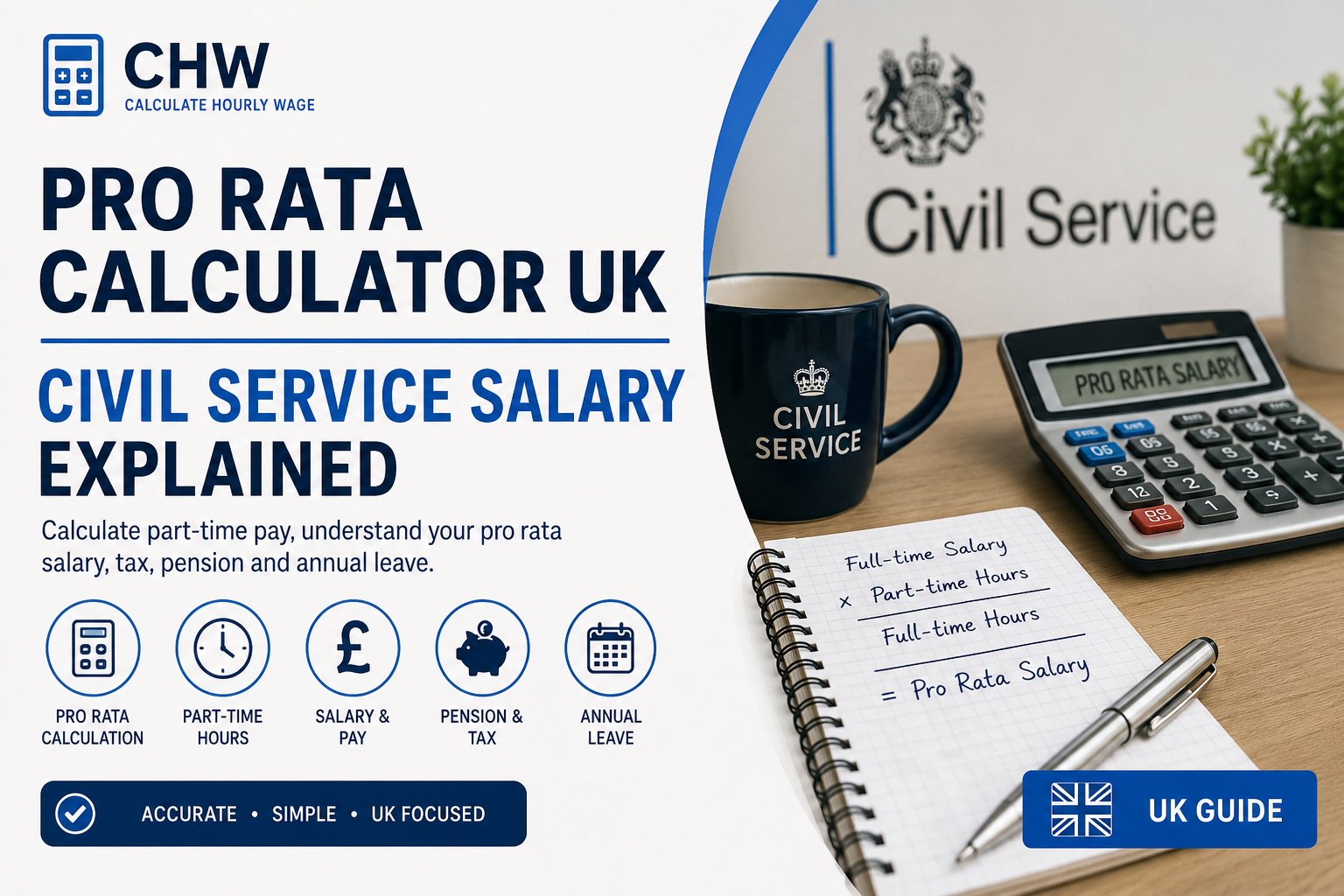
Pro Rata Salary = Full-Time Salary × Part-Time Hours ÷ Full-Time Hours
For example, suppose a full-time Civil Service role pays £30,000 a year for 37 hours per week.
An employee working 18.5 hours per week would work 50% of the full-time hours.
£30,000 × 18.5 ÷ 37 = £15,000
The employee’s annual basic salary would therefore be £15,000 before deductions.
The same principle can apply to other contractual benefits that are calculated proportionally, although not every payment or benefit is necessarily treated in exactly the same way.
How Is Civil Service Salary Calculated for Part-Time Workers?
The first step is to identify the full-time salary and the normal full-time weekly hours for the particular role.
Civil Service working hours can vary by department and contract, so you should use the hours stated in your employment documentation rather than automatically assuming a particular number.
Example: 30 Hours Per Week
Imagine a full-time Civil Service position pays £35,000 and the full-time working week is 37 hours.
You work 30 hours per week.
The calculation is:
£35,000 × 30 ÷ 37 = £28,378.38
Your approximate annual basic salary would therefore be £28,378.
Example: 20 Hours Per Week
Using the same £35,000 full-time salary:
£35,000 × 20 ÷ 37 = £18,918.92
The approximate pro rata salary would be £18,919 per year.
Example: Three Days a Week
Suppose your full-time working week is five days and you work three days.
Your working fraction is:
3 ÷ 5 = 60%
If the full-time salary is £40,000:
£40,000 × 60% = £24,000
Your basic annual salary would be approximately £24,000.
This approach works when the working pattern can reasonably be expressed as a proportion of the full-time arrangement.
Read More: Pro Rata Calculator UK- Term-Time Only SalaryCivil Service Salary and Full-Time Equivalent Pay
One important term to understand is full-time equivalent (FTE).
A job advertisement may show a salary range that represents the amount a full-time employee could earn. A part-time employee may receive a lower actual salary because they work fewer hours.
For example:
| Full-Time Salary | Full-Time Hours | Your Hours | Approx. Proportion | Pro Rata Salary |
|---|---|---|---|---|
| £30,000 | 37 | 18.5 | 50% | £15,000 |
| £32,000 | 37 | 20 | 54.05% | £17,297 |
| £35,000 | 37 | 25 | 67.57% | £23,649 |
| £40,000 | 37 | 30 | 81.08% | £32,432 |
| £45,000 | 37 | 37 | 100% | £45,000 |
These are examples rather than current salary scales. Always check the specific Civil Service vacancy or employment contract for the applicable salary.
How to Use a Pro Rata Calculator for Civil Service Salary
A Pro Rata Calculator UK can make these calculations much quicker.
You generally need three pieces of information:
- Your full-time annual salary
- The full-time weekly hours
- Your contracted weekly hours
Enter these values into the calculator and apply the pro rata formula.
For example:
- Full-time Civil Service Salary: £36,000
- Full-time hours: 37 hours
- Part-time hours: 25 hours
Calculation:
£36,000 × 25 ÷ 37 = £24,324.32
Estimated annual pro rata salary:
£24,324.32
You can then divide this figure by 12 to get an approximate gross monthly salary:
£24,324.32 ÷ 12 = £2,027.03
This is gross pay, not take-home pay.
Pro Rata Civil Service Salary Per Month
Once you know the annual pro rata salary, calculating the monthly gross amount is simple:
Monthly Gross Salary = Annual Pro Rata Salary ÷ 12
For example, if your pro rata annual salary is £24,000:
£24,000 ÷ 12 = £2,000
Your average monthly gross salary would be £2,000.
However, your actual payslip may not always look exactly like this if you receive additional payments, adjustments, allowances, salary changes or deductions.
Read More: Pro Rata Calculator UK- Fixed-Term Contract PayWhat About Tax and National Insurance?
Pro rata salary calculations normally give you gross pay.
Your take-home pay will depend on deductions such as:
- Income Tax
- National Insurance
- Civil Service pension contributions
- Student loan repayments, if applicable
- Other payroll deductions
This means two employees with the same gross Civil Service Salary could receive different amounts in their bank accounts.
Income Tax depends on your taxable income and tax circumstances. National Insurance is calculated separately from Income Tax.
A pro rata calculator should therefore not be confused with a take-home pay calculator.
For an accurate estimate of net pay, you need to consider the applicable tax year, tax code, National Insurance position and other deductions.
Does Working Part-Time Affect Civil Service Pension?
Working part-time can affect pension contributions and the benefits you build up, but the exact effect depends on the pension scheme, pensionable earnings and your circumstances.
Civil Service employees may be members of the Civil Service pension arrangements, with schemes and rules depending on factors such as when they joined and their employment circumstances.
For a part-time employee, pensionable pay and pension contributions need to be considered separately from the basic pro rata salary calculation.
If you are considering reducing your hours, do not rely only on the salary figure. Check how the change could affect your pension and request an illustration where appropriate.
Civil Service Salary and Annual Leave for Part-Time Employees
Annual leave is another area where part-time Civil Service employees need to be careful.
A part-time employee generally receives their entitlement on a pro rata basis compared with a full-time employee. However, the way leave is recorded can depend on the employee’s working pattern.
For example, someone working fewer days but longer hours may have a different number of leave days recorded than someone working the same total weekly hours spread across more days.
Bank holidays can also affect calculations for part-time employees.
This is why annual leave should not simply be calculated by taking the full-time number of days and applying a percentage without checking the relevant Civil Service policy.
What If Your Civil Service Hours Change?
If you move from full-time to part-time work, your basic salary will normally be adjusted to reflect your new contracted hours.
For example, assume:
- Full-time salary: £42,000
- Full-time hours: 37 hours
- New hours: 27 hours
The calculation is:
£42,000 × 27 ÷ 37 = £30,648.65
The new gross annual salary would be approximately £30,649.
If you later increase your hours, the same formula can be used to estimate the corresponding salary.
Your employer’s payroll system will use the contractual information and applicable employment terms to determine the actual amount paid.
Does Pro Rata Pay Apply to Civil Service Allowances?
Not necessarily in the same way for every allowance.
Some payments may be linked to working hours or contractual arrangements, while others may have their own rules.
Examples could include:
- Location-related allowances
- Role-specific allowances
- Shift-related payments
- Overtime
- Recruitment or retention payments
- Other contractual allowances
You should therefore avoid assuming that every part of your compensation can be calculated simply by multiplying it by your part-time percentage.
The safest approach is to check the specific terms of the role and the relevant departmental policy.
Civil Service Salary: Overtime and Additional Hours
Part-time Civil Service employees may sometimes work additional hours, but additional hours and overtime are not necessarily the same thing.
Whether additional hours qualify for overtime rates depends on the employee’s contract, grade, working arrangement and applicable departmental rules.
For example, an employee contracted for 20 hours per week who works 25 hours in a particular week should not automatically assume that all five additional hours will receive an overtime premium.
The treatment of extra hours can depend on the circumstances.
If you regularly work additional hours, check how your department records and pays them.
Read More: Rata Calculator UK – Paternity Leave PayWhat If You Work Term-Time Only?
Some employees may have working arrangements where they work during certain parts of the year rather than throughout the entire year.
A term-time-only arrangement can make salary calculations more complicated because the employee’s working weeks and annual leave arrangements need to be considered.
You should not automatically use the standard part-time formula if you are not working throughout the whole year.
For these arrangements, the employer may calculate annual pay using the contractual working pattern and relevant leave entitlement.
A term-time-only employee should check the contract or ask payroll for the full-time equivalent salary, working weeks and annualised pay calculation.
Civil Service Salary Example: Comparing Full-Time and Part-Time Pay
Consider a hypothetical Civil Service role with a full-time salary of £38,000 and a 37-hour working week.
An employee considers three possible working patterns.
| Weekly Hours | Calculation | Approx. Annual Salary |
|---|---|---|
| 37 | £38,000 × 37 ÷ 37 | £38,000 |
| 30 | £38,000 × 30 ÷ 37 | £30,811 |
| 25 | £38,000 × 25 ÷ 37 | £25,676 |
| 20 | £38,000 × 20 ÷ 37 | £20,541 |
This makes it easier to compare different working arrangements before requesting a change in hours.
Remember that these figures are gross estimates and do not represent guaranteed take-home pay.
Common Mistakes When Calculating Civil Service Pro Rata Pay
Using the wrong full-time hours
This is one of the easiest mistakes to make.
Do not assume that every Civil Service role uses the same full-time weekly hours. Use the hours specified for your role.
Calculating from the wrong salary
Make sure you use the full-time salary that applies to your grade, department, location and role.
If your salary range has multiple points, use the salary point that applies to you.
Treating gross pay as take-home pay
A pro rata salary is generally a gross figure.
Tax, National Insurance, pension contributions and other deductions can reduce the amount you receive.
Applying the same percentage to every benefit
Salary, pension, annual leave, allowances and overtime can have different rules.
Check each item separately.
Ignoring changes during the tax year
If your hours or salary change part way through the year, your annual income may not simply match one full-year pro rata calculation.
For example, if you work full-time for six months and part-time for six months, your total annual earnings will need to reflect both periods.
How to Calculate Civil Service Salary After a Mid-Year Hours Change
Suppose an employee earns £36,000 on a full-time basis for the first six months of the year and then moves to 50% hours for the remaining six months.
Full-time monthly equivalent:
£36,000 ÷ 12 = £3,000
Six months full-time:
£3,000 × 6 = £18,000
At 50%, the annual equivalent salary becomes:
£36,000 × 50% = £18,000
Six months at the part-time rate:
£18,000 ÷ 12 × 6 = £9,000
Total estimated gross pay for the year:
£18,000 + £9,000 = £27,000
This example shows why your expected annual earnings can differ from the full-time salary or the new pro rata salary shown on your employment records.
Why a Pro Rata Calculator Is Useful
A Pro Rata Calculator UK can help you:
- Estimate part-time Civil Service Salary
- Compare different working patterns
- Calculate annual gross pay
- Estimate average monthly gross pay
- Check whether a salary figure looks reasonable
- Compare full-time and part-time employment
- Plan household finances before reducing your hours
- Understand the financial effect of a job-share arrangement
It is particularly useful when you are considering a change in working hours and want a quick estimate before discussing the change with your employer.
Expert Tips Before Changing Your Civil Service Hours
Before moving from full-time to part-time work, check more than your basic salary.
1. Confirm your contractual hours.
Use the exact full-time and part-time hours stated in your employment arrangements.
2. Check your salary point.
Civil Service grades can have different salary ranges and departmental arrangements.
3. Ask about pension implications.
A reduction in pensionable earnings can affect contributions and future benefits.
4. Check annual leave.
Your leave entitlement and the way bank holidays are handled may change with your working pattern.
5. Ask about allowances.
Some allowances may have separate eligibility or calculation rules.
6. Estimate your net income.
Use your pro rata gross salary as the starting point, then consider Income Tax, National Insurance, pension and other deductions.
7. Get confirmation from HR or payroll.
A calculator provides an estimate. Your employer’s payroll calculation determines your actual contractual pay.
How do I calculate a pro rata Civil Service Salary?
Use the formula:
Full-Time Salary × Your Weekly Hours ÷ Full-Time Weekly Hours
For example, £35,000 at 25 hours compared with a 37-hour full-time week gives approximately £23,649 per year.
Is Civil Service Salary reduced pro rata for part-time work?
In many cases, basic salary is adjusted in proportion to contracted hours. However, individual allowances, overtime and other contractual payments can have separate rules.
Does a part-time Civil Service employee pay less tax?
A lower gross salary may result in lower Income Tax, depending on total taxable income and personal circumstances. Tax is based on taxable income rather than simply being a fixed percentage of your full-time salary.
Does working part-time reduce Civil Service pension contributions?
Pension contributions are generally linked to pensionable earnings and the applicable pension scheme. Moving to part-time work can therefore change the amount contributed and may affect future pension benefits.
Can I use a pro rata calculator for a Civil Service job?
Yes. A pro rata calculator can provide a useful estimate when you know the full-time salary, full-time hours and your contracted hours.
Is the result from a pro rata calculator my take-home salary?
No. The result is normally a gross salary estimate. Your actual take-home pay depends on Income Tax, National Insurance, pension contributions and other deductions.
What if my Civil Service working hours change during the year?
Calculate the pay for each period separately. Add the amounts together to estimate your total gross earnings for the year.
Final Thoughts
Understanding how a Civil Service Salary works on a part-time basis can make it much easier to compare working arrangements and plan your finances.
The basic calculation is straightforward:
Pro Rata Salary = Full-Time Salary × Your Hours ÷ Full-Time Hours
However, salary is only one part of the picture. Pension contributions, annual leave, allowances, overtime, tax and National Insurance can all affect the financial outcome of changing your hours.
A Pro Rata Calculator UK is useful for getting a quick estimate, but your Civil Service department, HR team or payroll provider should be treated as the final source for your actual contractual salary and benefits.
When comparing jobs or considering a change in hours, start with the full-time equivalent salary, apply the correct working-hours ratio, and then review the deductions and benefits that apply to your individual circumstances.