
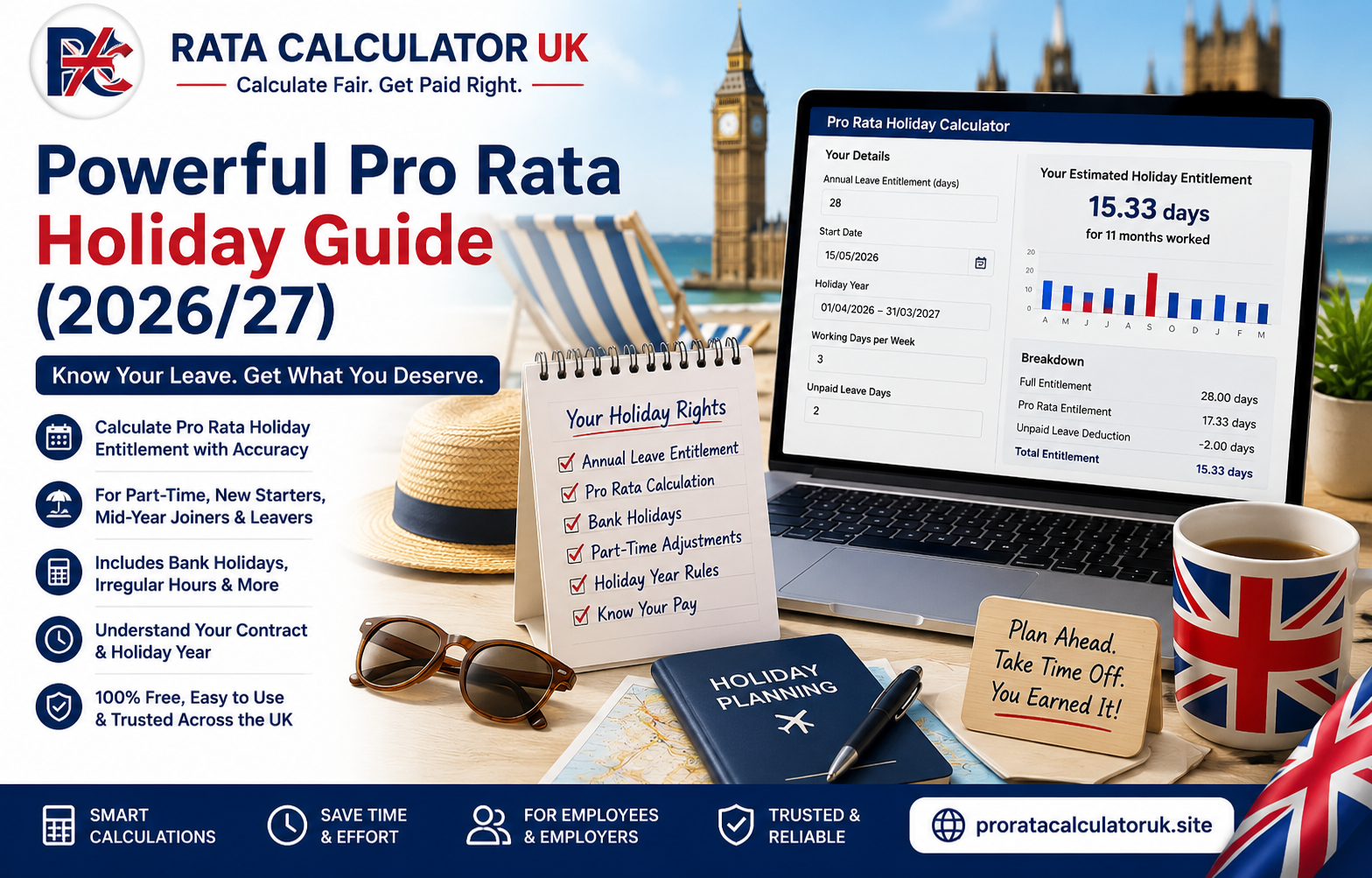
You start a new job in the middle of the holiday year, check your employee portal, and notice that your annual leave balance looks much smaller than expected.
Or perhaps you work three days a week and wonder why a full-time colleague has 28 days of leave while your allowance is lower. It can feel unfair at first, especially when bank holidays, part-time hours and different holiday-year dates are involved.
This is where a Rata Calculator UK can help. It gives you a clearer estimate of how much annual leave you may be entitled to when you work part-time, join or leave a job mid-year, work irregular hours, or have a holiday allowance that includes bank holidays.
However, holiday entitlement is not always as simple as dividing days by 12. Your contract, working pattern, holiday year and employer’s policy can all change the final result.
What Is Pro Rata Holiday Entitlement in the UK?
Pro rata holiday entitlement means annual leave is calculated in proportion to the time you work.
For example, a full-time employee who works five days per week may receive 28 days of paid annual leave each year. This is the statutory minimum for most workers in the UK and is equal to 5.6 weeks of paid holiday.
If another employee works three days per week, they are still entitled to 5.6 weeks of holiday. Their allowance is simply converted to match their working pattern.
Important: Part-time workers should not receive less holiday than full-time workers simply because they work fewer days. Their entitlement should be calculated fairly based on the number of days or hours they work.
A Rata Calculator UK helps estimate this proportional entitlement.
Who Needs a Pro Rata Holiday Entitlement Calculator?
A pro rata holiday calculator can be useful for many different employment situations.
You may need one if you are:
- Working part-time
- Starting a new job during the holiday year
- Leaving employment before the holiday year ends
- Changing from full-time to part-time work
- Changing your contracted working days
- Working compressed hours
- Working shifts or rotating patterns
- Working term-time only
- Working through an agency
- Working on a zero-hours or irregular-hours contract
- Returning from maternity, paternity, adoption or shared parental leave
- Checking whether your final holiday payment is correct
UK Statutory Holiday Entitlement Rules
Most workers in the UK are entitled to at least 5.6 weeks of paid annual leave each year. For someone working five days per week, this equals 28 days.
The 28-day maximum applies to the statutory minimum. Therefore, a worker who normally works six days each week is still usually entitled to a maximum of 28 statutory paid days.
Your employer can offer more than the legal minimum. Many contracts provide 25 days plus bank holidays, 30 days plus bank holidays, or a higher allowance based on length of service.
Visit Now: Mauricette CalculetteAre Bank Holidays Included in Annual Leave?
Bank holidays do not automatically have to be given as extra paid leave.
An employer can include bank holidays within the statutory 5.6-week allowance, provided the total paid holiday still meets the legal minimum.
For example, a contract may state:
- 20 days annual leave plus 8 bank holidays
- 28 days annual leave including bank holidays
- 25 days annual leave plus bank holidays
- 30 days annual leave plus bank holidays
The wording in your contract matters.
How a Rata Calculator UK Calculates Holiday Entitlement
A Rata Calculator UK usually works by taking your full annual holiday allowance and adjusting it for your working pattern or the portion of the holiday year you worked.
To make a useful estimate, you will usually need:
| Information | Why It Matters |
|---|---|
| Full-time holiday allowance | This is the starting point for the calculation |
| Holiday year dates | Your employer may use January to December, April to March, or another period |
| Start date or leave date | Needed when you work only part of the holiday year |
| Working days per week | Important for fixed part-time schedules |
| Weekly contracted hours | Useful for hourly or irregular work patterns |
| Bank holiday policy | Determines whether bank holidays reduce your leave balance |
| Leave already taken | Important when checking remaining entitlement or final pay |
Pro Rata Holiday Entitlement Formula
The basic formula is:
Pro rata holiday entitlement = Full annual holiday allowance × Proportion of time worked
For part-time employees with fixed weekly days, a common calculation is:
Full-time holiday allowance × Part-time working days ÷ Full-time working days
For example, if a full-time employee receives 28 days and works five days per week, a three-day-per-week employee may receive:
28 × 3 ÷ 5 = 16.8 days
Some employers may round this to 17 days, 16.5 days or another figure based on their holiday policy.
Calculating Holiday Entitlement for Part of a Holiday Year
If you only work part of the holiday year, the formula may be:
Annual holiday allowance × Days employed in the holiday year ÷ Total days in the holiday year
For example, if your annual entitlement is 28 days and you work half of the holiday year:
28 × 6 ÷ 12 = 14 days
A new starter may also accrue leave monthly. For regular-hours workers, an employer can use an accrual system where holiday builds at one-twelfth of the annual allowance each month.
How to Calculate Pro Rata Holiday Entitlement Step by Step
Step 1: Check Your Employer’s Holiday Year
Do not assume the holiday year runs from January to December.
Your employer may use:
- 1 January to 31 December
- 1 April to 31 March
- 1 September to 31 August
- Your employment anniversary date
- Another period set out in your contract
The holiday year is important because your entitlement is normally calculated within that specific period.
Step 2: Confirm Your Full-Time Holiday Allowance
Check your employment contract, offer letter, employee handbook or HR portal.
Look for wording such as:
- “28 days including bank holidays”
- “25 days plus bank holidays”
- “30 days annual leave”
- “5.6 weeks paid holiday”
- “Holiday entitlement is calculated in hours”
Do not use the statutory minimum if your contract provides a higher allowance.
Step 3: Confirm Your Working Pattern
For fixed part-time work, identify how many days or hours you work compared with a full-time employee.
For example:
| Working Pattern | Full-Time Pattern | Proportion Worked |
|---|---|---|
| 3 days per week | 5 days per week | 60% |
| 4 days per week | 5 days per week | 80% |
| 18 hours per week | 37.5 hours per week | 48% |
| 24 hours per week | 40 hours per week | 60% |
Step 4: Work Out the Portion of the Holiday Year Worked
If you join or leave mid-year, calculate how much of the holiday year you were employed.
For a simple monthly estimate:
Months worked ÷ 12
For a more precise estimate:
Days employed ÷ Total days in the holiday year
A worker who starts part-way through a leave year is entitled to a proportion of the annual leave allowance for the time remaining in that leave year.
Step 5: Apply the Pro Rata Formula
Multiply your annual entitlement by your working proportion and, if relevant, the proportion of the holiday year worked.
For example, a three-day-per-week employee has a full-time equivalent allowance of 28 days and works for half of the holiday year:
28 × 3 ÷ 5 = 16.8 days per year
16.8 × 6 ÷ 12 = 8.4 days
Step 6: Check Your Employer’s Rounding Policy
Employers may round holiday entitlement to:
- The nearest half day
- The nearest full day
- The nearest hour
- The nearest quarter day
- The exact decimal amount
Rounding should be handled fairly and should not reduce statutory entitlement below the legal minimum.
Pro Rata Holiday Entitlement Examples
Example: Part-Time Employee Working Three Days Per Week
A full-time employee works five days per week and receives 28 days of holiday, including bank holidays.
A part-time employee works three days per week.
28 × 3 ÷ 5 = 16.8 days
Depending on company policy, this may be rounded to 17 days.
Example: New Starter Joining Halfway Through the Holiday Year
A company holiday year runs from 1 January to 31 December.
A new employee starts on 1 July and has an annual entitlement of 28 days.
28 × 6 ÷ 12 = 14 days
If the employer uses a monthly accrual method, the employee may build up holiday at roughly 2.33 days per month.
Example: Employee Leaving After Eight Months
An employee has 30 days of annual leave and leaves after working eight months of the holiday year.
30 × 8 ÷ 12 = 20 days
If they have already taken 22 days, they may have taken two days more than they accrued.
Whether an employer can deduct pay for overtaken holiday depends on the contract and the circumstances.
Example: Compressed Hours Employee
A worker completes 37.5 hours across four longer days instead of five standard days.
Calculating holiday only in days can create problems because one day of leave may represent more hours than a standard day.
For this reason, many employers calculate holiday in hours:
Weekly contracted hours × 5.6 weeks
37.5 × 5.6 = 210 hours annual leave
This approach can be fairer for compressed-hours employees.
Example: Zero-Hours Worker Holiday Accrual
For irregular-hours and part-year workers, holiday is commonly accrued at 12.07% of hours worked in a pay period when calculating the statutory minimum.
If a worker completes 80 hours during a monthly pay period:
80 × 12.07% = 9.66 hours of holiday accrued
If the contract offers more than the statutory minimum, the percentage may need to be adjusted.
Read More: Rata Calculator UK-Best Part-Month Salary Guide (2026/27)Holiday Entitlement in Days vs Hours
Holiday can be calculated in days, hours or weeks.
The best method depends on the employee’s working pattern.
| Method | Best For | Main Benefit |
|---|---|---|
| Days | Employees with fixed daily schedules | Easy to understand |
| Hours | Part-time staff, compressed hours and variable shifts | More accurate and fair |
| Weeks | Workers with regular weekly patterns | Matches statutory entitlement |
| Percentage accrual | Irregular-hours and part-year workers | Tracks actual hours worked |
When Holiday Should Be Calculated in Hours
Calculating leave in hours can be more accurate when:
- Daily shifts are different lengths
- Employees work compressed hours
- Part-time staff work different hours on different days
- Shift patterns rotate
- Employees work irregular hours
- Bank holidays create unequal outcomes
For example, someone who works 10 hours on Monday and 5 hours on Tuesday should not necessarily lose the same number of holiday hours for each day off.
How Bank Holidays Affect Pro Rata Holiday Entitlement
Bank holidays are one of the most confusing parts of pro rata leave calculations.
Part-time employees are not automatically entitled to every bank holiday as extra paid leave. The outcome depends on the contract and whether bank holidays are included within the overall allowance.
What If a Bank Holiday Falls on a Non-Working Day?
Suppose a part-time employee works Tuesday, Wednesday and Thursday, while a bank holiday falls on Monday.
If the employer gives bank holidays in addition to annual leave, the employee may not receive paid time off for that Monday because it is not normally a working day.
However, if bank holidays are included within a pro rata annual allowance, calculating entitlement in hours can help prevent unfair treatment across different working patterns.
Bank Holidays Included Within Annual Leave
If your contract says “28 days including bank holidays,” bank holidays may reduce your remaining leave balance.
For example, a full-time worker may have eight bank holidays deducted from the 28-day total, leaving 20 days to book.
For part-time workers, the employer should apply the policy fairly. A simple days-based system can sometimes disadvantage workers whose non-working days regularly fall on bank holidays.
Read More:
Holiday Accrual During Leave and Absence
Holiday entitlement does not stop simply because an employee is away from work.
Sickness Absence
Workers continue to build up statutory holiday while they are off sick. They may be able to take holiday during sickness absence or carry some leave forward where they could not take it because of illness.
Maternity, Paternity and Adoption Leave
Holiday continues to accrue during statutory maternity, paternity and adoption leave. This includes bank holidays where they are part of the employee’s entitlement.
Shared Parental Leave
Annual leave generally continues to accrue during shared parental leave because the employment relationship continues.
Unpaid Leave
Unpaid leave can be more complicated. Your contract and the type of leave may determine whether holiday continues to build up. Speak to HR if you are taking a lengthy unpaid break.
Pro Rata Holiday Pay When Leaving a Job
When you leave a job, your employer should calculate how much holiday you accrued up to your final employment date.
Your final payslip may include:
- Salary up to your leaving date
- Payment for untaken accrued holiday
- Overtime or commission adjustments
- A deduction for holiday taken above your accrued entitlement, where permitted
A useful formula is:
Holiday accrued to leaving date − Holiday already taken = Remaining holiday balance
If the balance is positive, you may be owed holiday pay. If it is negative, you may have taken more holiday than you earned.
Important: Employers should not make deductions from final pay unless they have a legal basis or contractual authority to do so. Check your contract before accepting a deduction.
Common Pro Rata Holiday Entitlement Mistakes
Using the Wrong Holiday Year
Many employees calculate from January to December when their employer actually uses April to March or another period.
Forgetting Bank Holidays
A contract that includes bank holidays within annual leave will produce a different result from one that gives bank holidays separately.
Using Days for an Irregular Working Pattern
Days can be misleading when shifts vary in length. Hours are often more accurate.
Ignoring Contractual Holiday Above the Statutory Minimum
Your employer may offer more than 5.6 weeks. Always calculate from your actual contractual allowance.
Rounding Too Early
Round only at the final stage unless your employer’s policy says otherwise. Rounding each monthly calculation can create avoidable differences.
Assuming Holiday Stops During Maternity or Sickness Leave
Statutory holiday continues to accrue during these periods.
Expert Tips for Using a Rata Calculator UK
- Check whether bank holidays are included in your allowance.
- Confirm your employer’s holiday-year dates before calculating.
- Use hours instead of days if your shifts vary.
- Keep a record of holiday booked, taken and remaining.
- Review your contract and employee handbook for rounding rules.
- Check your entitlement after changing hours or working days.
- Ask HR for a written breakdown if your balance seems incorrect.
- Use your actual contractual allowance, not only the statutory minimum.
- Check accrued holiday before leaving a job.
- Treat a calculator result as an estimate until your employer confirms it.
Related Rata Calculator UK Tools
You may also find these tools useful:
- Pro Rata Salary Calculator
- Holiday Pay Calculator UK
- Final Pay Calculator UK
- Part-Time Salary Calculator UK
- Hourly Rate Calculator UK
- Take-Home Pay Calculator UK
- Overtime Pay Calculator UK
What is a pro rata holiday entitlement calculator UK?
A pro rata holiday entitlement calculator estimates annual leave for part-time employees, new starters, leavers and workers who only work part of a holiday year.
How do I calculate holiday entitlement for part-time work?
Multiply the full-time annual leave allowance by the proportion of full-time days or hours you work. For example, working three days instead of five means you work 60% of the full-time pattern.
How much holiday do I get if I start work halfway through the holiday year?
You normally receive a proportion of the annual entitlement for the part of the holiday year you work. A simple estimate is half of the annual allowance if you work exactly six months.
Do part-time workers get bank holidays in the UK?
Part-time workers are entitled to fair holiday treatment, but bank holiday entitlement depends on the employment contract. Bank holidays may be included within the overall leave allowance.
Does holiday entitlement accrue during maternity leave?
Yes. Employees continue to build up annual leave during statutory maternity leave, including bank holidays where relevant.
Does annual leave build up during sick leave?
Yes. Workers continue to accrue statutory holiday during sickness absence.
How is holiday entitlement calculated for zero-hours workers?
For irregular-hours workers, statutory holiday is commonly accrued at 12.07% of hours worked in each pay period.
Can my employer deduct pay if I take more holiday than I have earned?
An employer may be able to recover overtaken holiday pay if the contract allows it or there is another legal basis for the deduction. Check your contract and ask for a written calculation.
Should pro rata holiday entitlement be calculated in days or hours?
Days can work well for fixed schedules. Hours are often fairer for variable shifts, compressed hours and part-time employees with different daily hours.
What happens to unused holiday when I leave my job?
Your employer should usually pay you for holiday you accrued but did not take before leaving. The amount should appear on your final payslip.
Conclusion
A Rata Calculator UK can make pro rata holiday entitlement much easier to understand, whether you work part-time, start mid-year, change your hours or prepare to leave a job.
The most accurate calculation starts with your contract. Check your holiday year, full-time allowance, bank holiday policy and working pattern, then use a calculator to estimate your entitlement before comparing it with your employer’s records.