
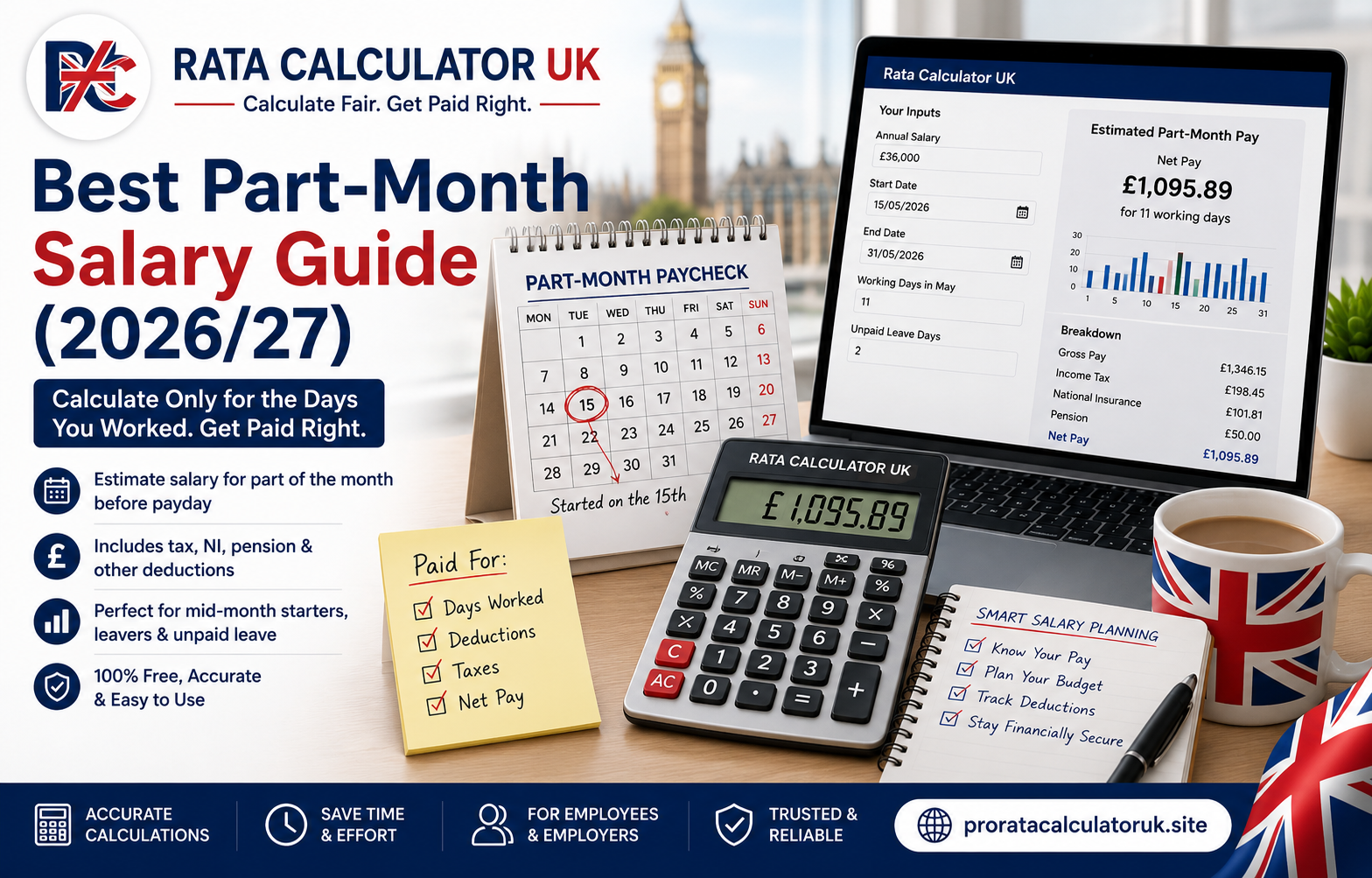
Starting a new job halfway through the month can feel exciting until you try to work out what will actually arrive in your bank account on payday.
Your contract may show an annual salary of £30,000, £36,000 or £45,000. However, if you start on the 15th, leave before month-end, take unpaid leave or reduce your hours, you will not usually receive the full monthly amount.
This is where a Rata Calculator UK becomes useful. It helps you estimate your salary for the exact part of the month you worked, before tax, National Insurance, pension deductions and other payroll adjustments are applied.
What Is a Rata Calculator UK?
A Rata Calculator UK is an online tool used to estimate pro rata pay. Pro rata means “in proportion.”
Instead of paying a full monthly salary, an employer calculates the amount based on the portion of the pay period you were entitled to be paid for.
For example, if your normal monthly salary is £3,000 but you only worked half of the month, your gross pay may be around £1,500. However, the exact figure depends on your employer’s payroll method.
A Rata Calculator UK can help estimate pay when you:
- Start a job during the month
- Leave a job before the end of the pay period
- Take unpaid leave
- Return from a career break
- Change from full-time to part-time hours
- Change your contracted working days
- Work reduced hours temporarily
- Need to check a first or final payslip
Read More: Rata Calculator UK for EmployeesWhat Does Pro Rata Pay Mean in the UK?
Pro rata pay means your salary is adjusted according to the time you worked or the hours you are contracted to work.
A full-time employee might earn £36,000 per year for working five days each week. If another employee works three days per week in the same role, their salary may be calculated on a pro rata basis.
The same principle applies when someone works only part of a month.
For instance, if you join a company on 16 June, your employer may calculate your first salary using:
- Calendar days in June
- Working days in June
- Annual working days
- A fixed monthly payroll method
- The company’s own contract-based formula
This is why two employees with the same annual salary can receive different first-month pay figures at different companies.
When Do You Need to Calculate Salary for Part of a Month?
Part-month salary calculations are common, but they can still cause confusion because payroll rules vary from employer to employer.
Starting a New Job Mid-Month
If you begin work after the first day of the month, you may only be paid for the days you were employed during that pay period.
For example, if your payday covers 1 April to 30 April and you start on 16 April, your first salary will normally be lower than your regular monthly salary.
Leaving Employment Before Payday
When leaving a job, your final payslip may include salary up to your final working day. It may also include holiday pay for unused annual leave, overtime, commission or deductions.
Your final payment can look different from your usual payslip because several adjustments may be included at once.
Unpaid Leave or Career Breaks
If you take unpaid leave, your employer may deduct pay for the days you were absent. The calculation may use working days, calendar days or an annual daily rate.
Changes to Working Hours
A move from full-time to part-time work can affect your salary. For example, if you reduce your working week from five days to three days, your annual salary may be recalculated based on 60% of the full-time equivalent salary.
Why Part-Month Salary Calculations Matter
It is easy to look at an annual salary and assume that dividing it by 12 gives the amount you will receive every month.
In reality, that only applies when you work the full pay period and there are no adjustments.
Your first or final salary can be affected by:
- Your start or leave date
- Payroll cut-off dates
- Paid and unpaid days
- Bank holidays
- Weekend treatment
- Contracted working pattern
- Overtime payments
- Bonus payments
- Pension contributions
- PAYE tax code
- National Insurance deductions
- Student loan repayments
- Holiday pay adjustments
A calculator gives you a useful estimate, but your contract and payroll policy decide the final figure.
Visit Now: Mauricette CalculetteHow Does a Rata Calculator UK Work?
A Rata Calculator UK takes your annual salary, pay frequency and relevant dates, then estimates the proportion of salary you earned.
Most calculators need the following information:
| Information Needed | Why It Matters |
|---|---|
| Annual salary | Used to calculate your full monthly or daily pay |
| Pay frequency | Monthly, weekly or four-weekly pay can affect the calculation |
| Start date or leave date | Determines how much of the pay period you worked |
| Pay period dates | Helps identify the correct days to include |
| Payroll method | Calendar days, working days or annual days can produce different results |
| Unpaid leave days | May reduce your salary |
| Contracted working pattern | Important for part-time employees |
Rata Calculator UK Formula for Part of a Month Salary
The basic formula is simple:
Pro rata pay = Full pay for the period × Eligible days worked ÷ Total days in the pay period
However, the result changes depending on how your employer defines “days.”
Annual Salary to Monthly Salary Formula
For employees paid monthly, the first step is usually:
Monthly salary = Annual salary ÷ 12
For example:
| Annual Salary | Monthly Gross Salary |
|---|---|
| £24,000 | £2,000 |
| £30,000 | £2,500 |
| £36,000 | £3,000 |
| £42,000 | £3,500 |
| £48,000 | £4,000 |
If your annual salary is £36,000, your usual monthly gross salary is:
£36,000 ÷ 12 = £3,000
Daily Rate Formula Using Calendar Days
If payroll uses calendar days:
Daily rate = Monthly salary ÷ Number of calendar days in the month
For a £3,000 monthly salary in a 30-day month:
£3,000 ÷ 30 = £100 per calendar day
If you worked 15 eligible calendar days:
£100 × 15 = £1,500 gross pay
Daily Rate Formula Using Working Days
If payroll uses working days:
Daily rate = Monthly salary ÷ Working days in the month
If there are 22 working days in the month:
£3,000 ÷ 22 = £136.36 per working day
If you worked 11 working days:
£136.36 × 11 = £1,500 gross pay
The figure may look similar in this example, but it can vary significantly depending on the month, weekends, bank holidays and your start date.
Annual Working Days Method
Some employers use an annual method instead of calculating from the number of days in a specific month.
A common formula is:
Daily rate = Annual salary ÷ 260 working days
For an annual salary of £36,000:
£36,000 ÷ 260 = £138.46 per day
If you worked 10 eligible days:
£138.46 × 10 = £1,384.60 gross pay
This method may produce a different result from a calendar-day or monthly working-day calculation.
How to Calculate Salary for Part of a Month Step by Step
Use these steps before relying on any estimated result.
Step 1: Find Your Annual Gross Salary
Check your employment contract, offer letter or latest payslip.
Use your contracted annual salary rather than including overtime, bonuses, commission or occasional allowances unless your employer confirms they are included.
Step 2: Work Out Your Normal Monthly Salary
Divide your annual salary by 12.
For example:
£31,200 ÷ 12 = £2,600 per month
This is your full monthly gross salary before deductions.
Step 3: Check Your Employer’s Pay Calculation Method
Your employer may calculate pro rata pay using:
- Calendar days
- Working days
- Annual working days
- Fixed monthly salary rules
- A specific formula written in your contract
This step matters because using the wrong method can make your estimate inaccurate.
Step 4: Count Eligible Paid Days
Count the days you were entitled to pay during the relevant pay period.
For a new starter, this may begin on your official employment start date. For someone leaving, it may end on their final contracted day.
Remember to consider:
- Weekends
- Bank holidays
- Paid annual leave
- Unpaid leave
- Sick leave
- Notice period
- Garden leave
- Contracted workdays
Step 5: Calculate Your Estimated Pro Rata Pay
Use the formula that matches your employer’s method.
For example, if your monthly salary is £2,600, there are 20 working days in the month and you worked 8 eligible days:
£2,600 ÷ 20 = £130 daily rate
£130 × 8 = £1,040 gross pay
Step 6: Check Deductions Before Comparing With Your Payslip
A Rata Calculator UK normally estimates gross pay, not take-home pay.
Your actual bank payment may be lower because of:
- Income Tax
- National Insurance
- Workplace pension contributions
- Student loan repayments
- Salary sacrifice arrangements
- Court orders
- Union subscriptions
- Company benefit deductions
Rata Calculator UK-Salary Calculation by Different Methods
Different payroll methods can produce different results even when the annual salary and start date are identical.
| Method | Formula | Best Used When | Possible Difference |
|---|---|---|---|
| Calendar days | Monthly salary ÷ days in month | Employer treats every calendar day as part of the pay period | Weekends may affect the result |
| Working days | Monthly salary ÷ working days | Employee works a standard weekday pattern | Bank holidays and workdays matter |
| Annual working days | Annual salary ÷ annual workdays | Employer uses a consistent annual daily rate | Monthly totals may vary |
| Fixed monthly method | Contract-specific calculation | Employer has its own payroll rule | Must check contract or payroll team |
Pro Rata Salary Examples for Part of a Month
Example: Starting Work Halfway Through the Month
Sana starts a new job on 16 September. Her annual salary is £36,000.
Her normal monthly salary is:
£36,000 ÷ 12 = £3,000
September has 30 calendar days. If her employer uses calendar days and pays her for 15 days:
£3,000 ÷ 30 = £100 per day
£100 × 15 = £1,500 gross pay
Her take-home pay will be lower after deductions.
Example: Leaving Before Month-End
Adam earns £42,000 per year and leaves his job on the 20th of a 31-day month.
His normal monthly salary is:
£42,000 ÷ 12 = £3,500
If the employer uses calendar days and Adam is paid for 20 days:
£3,500 ÷ 31 = £112.90 per day
£112.90 × 20 = £2,258.00 gross pay
His final payslip may also include unused holiday pay or deductions.
Example: Salary After Unpaid Leave
Mariam earns £30,000 annually and takes five unpaid working days in a month with 22 working days.
Her normal monthly salary is:
£30,000 ÷ 12 = £2,500
Her daily working-day rate is:
£2,500 ÷ 22 = £113.64
Her unpaid leave deduction may be:
£113.64 × 5 = £568.20
Estimated gross salary for the month:
£2,500 − £568.20 = £1,931.80
Example: Part-Time Employee Working Three Days Per Week
A full-time role pays £40,000 per year for five days per week.
If an employee works three days per week:
£40,000 × 3 ÷ 5 = £24,000 pro rata annual salary
Their normal monthly gross pay would be:
£24,000 ÷ 12 = £2,000
If they start halfway through the month, payroll may then apply a second pro rata calculation to that £2,000 monthly salary.
Calendar Days vs Working Days: Which Method Is Better?
Neither method is automatically better. The correct method is the one your employer uses.
| Situation | Calendar Days May Be Used | Working Days May Be Used |
|---|---|---|
| Employee starts mid-month | Yes | Yes |
| Employee leaves mid-month | Yes | Yes |
| Unpaid leave deduction | Sometimes | Commonly |
| Standard Monday-to-Friday contract | Possible | Often used |
| Shift worker with varied days | Possible | Depends on contract |
| Weekend included in salary calculation | More likely | Less likely |
The key point is that your salary is usually governed by your employment contract and payroll policy, not by a universal UK rule.
Read More: Best Rata Calculator UK-Powerful First & Final Pay Guide (2026/27)Does a Rata Calculator UK Show Gross Pay or Take-Home Pay?
Most pro rata calculators show an estimate of gross pay.
Gross pay is your salary before deductions. Take-home pay is the amount you receive after deductions have been taken.
Your net pay can differ because PAYE tax is calculated through the tax year, not simply as a fixed percentage of every payslip. A first or final payslip can also be affected by your tax code, previous earnings, tax-free allowance, pension contributions and payroll timing.
For this reason, use a Rata Calculator UK to estimate your salary entitlement, then use a take-home pay calculator for a closer estimate of what may reach your bank account.
Why Your First Month’s Salary May Be Lower Than Expected
A lower first payslip does not always mean payroll made a mistake.
Common reasons include:
- You started after the beginning of the pay period
- You missed the payroll cut-off date
- You had unpaid days before your official start date
- Your employer uses working days rather than calendar days
- Pension contributions started immediately
- Your tax code was temporary or emergency-based
- You had student loan deductions
- Your pay period did not match the calendar month
- Overtime was moved to the next payroll run
If you are unsure, ask payroll for a written breakdown of the calculation.
Pro Rata Pay for New Starters in the UK
New starters are usually paid from their official start date, but the timing of their first payment depends on payroll cut-off dates.
For example, if payday is the 28th of each month but payroll closes on the 10th, someone who starts on the 15th may not receive their first payment until the following month.
That delayed payment may include:
- Salary from the start date
- Salary for the next full pay period
- Overtime or expenses if approved
- Pension and tax deductions
Always ask your employer these two questions before starting:
- What dates does the monthly pay period cover?
- What is the payroll cut-off date for new starters?
Pro Rata Pay for Employees Leaving a Job
Your final pay is often more complicated than a normal monthly salary calculation.
It may include:
- Salary up to your final employment date
- Payment for untaken annual leave
- Overtime or commission owed
- Bonus payments, where applicable
- Notice pay
- Pay in lieu of notice
- Pension deductions
- Student loan deductions
- Repayment of overpaid holiday or training costs, where permitted
Check your final payslip carefully, especially if you leave mid-month or have taken more holiday than you accrued.
Common Rata Calculator UK Mistakes to Avoid
Using Calendar Days When Payroll Uses Working Days
This is one of the most common mistakes. A calendar-day calculation may look reasonable, but it can be wrong if payroll only counts contracted workdays.
Assuming Gross Pay Equals Take-Home Pay
Your estimated gross salary may be accurate, but your bank payment can still be lower because of tax, National Insurance and pension deductions.
Forgetting Unpaid Leave
Unpaid leave can reduce your salary even if you worked most of the month.
Ignoring the Pay Period Dates
Your employer may pay from the 15th to the 14th rather than from the first to the last day of the month.
Missing Holiday Pay From Final Salary
If you leave a job with unused holiday entitlement, you may be owed additional payment. On the other hand, taking more holiday than you accrued may lead to a deduction.
Relying on an Estimate as a Final Figure
A calculator is useful for planning, but it cannot see your contract, payroll policy, tax code or deductions.
Expert Tips for Using a Rata Calculator UK
- Keep your contract, start date, leave date and payday details together.
- Use your contracted annual salary rather than estimated annual earnings.
- Confirm whether your employer uses calendar days, working days or annual days.
- Check whether weekends and bank holidays are included.
- Review your payroll cut-off date before expecting your first salary.
- Treat calculator results as estimates until your payslip arrives.
- Compare gross pay first, then review deductions separately.
- Ask payroll for a breakdown if your result differs from your payslip.
- Check holiday entitlement when leaving a job.
- Use a take-home pay calculator if you need a clearer estimate of net pay.
Related UK Salary Calculators You May Need
A part-month salary estimate is often only one part of the calculation.
You may also need:
- Hourly Rate Calculator UK
- Monthly Salary Calculator UK
- Take-Home Pay Calculator UK
- Holiday Pay Calculator UK
- Overtime Pay Calculator UK
- National Insurance Calculator UK
- Income Tax Calculator UK
These tools can help you understand the difference between your annual salary, gross pay and actual take-home pay.
What is a Rata Calculator UK used for?
A Rata Calculator UK estimates pro rata salary when you work only part of a month, change hours, start a new job, leave employment or take unpaid leave.
How do I calculate my salary for part of a month in the UK?
First calculate your normal monthly salary by dividing annual salary by 12. Then divide it by the number of calendar days or working days used by your employer and multiply it by the eligible paid days.
Do employers use calendar days or working days for pro rata pay?
Both methods are used. Your employment contract, payroll policy and working pattern determine which method applies.
How is pro rata salary calculated from an annual salary?
A common method is annual salary divided by 12 to find monthly pay. Payroll then calculates the proportion of that monthly amount based on the days worked or paid.
Will I be paid for weekends if I start work mid-month?
It depends on your employer’s calculation method. Calendar-day payroll methods may include weekends, while working-day methods usually focus on contracted workdays.
Does a Rata Calculator UK include tax and National Insurance?
Most calculators estimate gross pay before tax, National Insurance, pension contributions and other deductions.
Why is my first month’s salary lower than expected?
You may have started partway through the pay period, missed the payroll cut-off date, had deductions applied or been paid according to a different payroll method than expected.
How is final pay calculated when leaving a job in the UK?
Final pay normally includes salary up to your leave date, plus or minus adjustments such as unused holiday pay, overtime, deductions or notice pay.
Do I receive holiday pay when I leave my job?
You may receive payment for untaken holiday you have accrued. However, if you took more holiday than you earned, your employer may be allowed to deduct the overpayment if your contract permits it.
Can my employer use a different pro rata calculation method?
Yes. Employers can use different calculation methods as long as they follow the employment contract and applicable employment law. Ask payroll for the exact formula if you need to verify your payslip.
Conclusion
A Rata Calculator UK makes it easier to estimate your salary when you start or leave a job during the month, take unpaid leave or change your working hours.
The most important detail is not just your annual salary—it is the payroll method your employer uses. Check your contract, confirm the pay period dates and compare your estimate with your payslip before assuming there is an error.