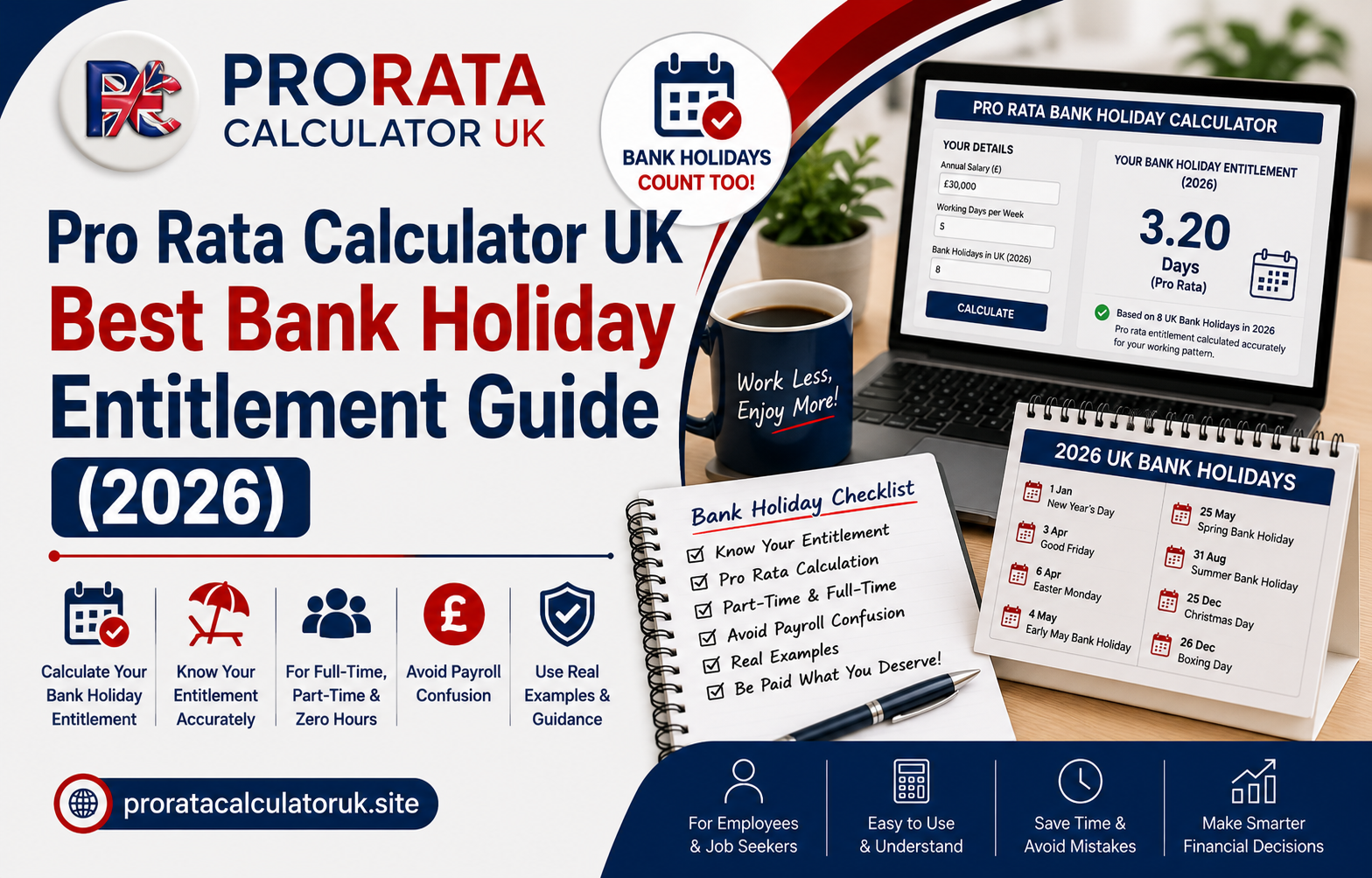
Pro Rata Calculator UK tools exist for exactly this reason: bank holidays cause more payroll confusion than almost anything else in UK employment. Full-time staff usually assume they get every bank holiday off, paid. Part-time staff often don’t — and that catches people out constantly, especially if you don’t work Mondays, which is when most UK bank holidays fall.
If you’ve ever wondered whether you’re actually entitled to bank holiday pay, or how to work out your fair share as a part-time or pro rata worker, this guide walks through exactly how it’s calculated, with real examples you can apply to your own contract.
Do You Automatically Get Bank Holidays Off in the UK?
No. This is the single biggest misconception around bank holiday entitlement.
There’s no legal right in the UK to take bank holidays off, paid or unpaid. What you’re legally entitled to is 5.6 weeks of paid holiday per year (for a full-time worker), and your employer can choose to include bank holidays within that allowance or offer them on top of it.
So the real question isn’t “do I get bank holidays off” — it’s “how does my employer count bank holidays within my holiday entitlement?”
Two Common Approaches Employers Use
- Bank holidays included in the 5.6 weeks. Your 28 days (for a 5-day week) already accounts for the 8 UK bank holidays. If you don’t work on a bank holiday because your contract says so, that day is deducted from your annual leave balance.
- Bank holidays given on top of statutory leave. Some employers offer 28 days’ annual leave plus bank holidays separately, effectively giving you more than the legal minimum.
Always check your contract or staff handbook to see which method your employer uses — this single detail changes every calculation that follows.
The Bank Holiday Entitlement Formula for Part-Time Workers
This is where pro rata calculations become essential. Since UK bank holidays always fall on specific weekdays (mostly Mondays), a part-time worker who doesn’t work Mondays could easily miss out on paid bank holiday leave if their entitlement isn’t calculated proportionally.
The standard formula UK employers use is:
Pro Rata Bank Holiday Entitlement = (Full-Time Holiday Entitlement ÷ 5) × Days Worked Per Week
This treats bank holidays as part of the wider statutory 5.6-week holiday entitlement, then works out your fair proportional share based on your working pattern — not on which specific days you happen to work.
Why This Matters
If bank holiday entitlement were based purely on “do you work that specific day,” someone who works Tuesday to Thursday would lose out compared to someone doing Monday to Wednesday, purely because of which days they’d chosen. Calculating it pro rata instead means everyone gets a fair proportional entitlement regardless of their exact working days.
Visit Now: MauricetteCalculetteStep-by-Step: Calculating Your Bank Holiday Entitlement
- Confirm your full-time entitlement. Most UK full-time employees get 28 days (5.6 weeks × 5 days), though some employers offer more.
- Confirm your working pattern. How many days a week do you actually work?
- Apply the pro rata formula. Divide your full-time entitlement by 5, then multiply by your working days.
- Check whether bank holidays are included or additional. This affects how the final number is used in practice.
- Convert to hours if needed. If you work variable hours rather than fixed days, your employer may calculate entitlement in hours instead — more on this below.
Read More: Rata Calculator UK-Powerful Pro Rata Holiday GuideExample 1: Standard Part-Time Worker
A worker on a 3-day week, with a full-time entitlement of 28 days:
28 ÷ 5 = 5.6 days per week worked
5.6 × 3 = 16.8 days' total annual leave (including bank holidays)
Out of this 16.8-day pool, the 8 UK bank holidays are proportionally accounted for — they’re not added separately.
Example 2: Worker Who Doesn’t Work Mondays
Say someone works Tuesday, Wednesday, and Thursday only. Since most bank holidays fall on Mondays, they’d rarely take a “bank holiday” off in the literal sense. But because their 16.8-day entitlement (from Example 1) is calculated pro rata rather than day-specific, they still receive the same total leave as anyone else working 3 days a week — they just take it as flexible leave rather than fixed bank holiday days.
Example 3: Zero-Hours or Variable-Hours Staff
For workers without fixed days, UK law allows holiday entitlement to be calculated as 12.07% of hours worked. This figure comes from dividing 5.6 weeks by the remaining 46.4 working weeks in a year.
Hours worked in a month × 12.07% = holiday hours accrued
Example: Someone works 60 hours in a month.
60 × 0.1207 = 7.24 hours of paid holiday accrued that month
This method is common in retail, hospitality, and casual contracts where hours change week to week.
Bank Holiday Entitlement Table by Working Pattern
Here’s a quick reference using a standard 28-day full-time entitlement.
| Days Worked Per Week | Pro Rata Annual Leave (Days) | Approx. Bank Holiday Share |
|---|---|---|
| 5 days (full-time) | 28 | 8 days |
| 4 days | 22.4 | 6.4 days |
| 3 days | 16.8 | 4.8 days |
| 2 days | 11.2 | 3.2 days |
| 1 day | 5.6 | 1.6 days |
These figures represent total annual leave including the proportional bank holiday share — not additional days on top.
Read More: Best Rata Calculator UK-Powerful Pro Rata PayWhat If a Bank Holiday Falls on a Day You Don’t Work?
This is one of the most common questions employees ask, and the answer depends on your employer’s specific policy, but the general principle under UK law is this: you shouldn’t lose out simply because of which days you’re contracted to work.
If your entitlement is calculated correctly on a pro rata basis (as shown above), a bank holiday falling on a non-working day doesn’t reduce your total leave — because your leave was never tied to specific calendar dates in the first place. Instead, you take your pro rata days whenever suits you and your employer, spread across the year.
Where employers get this wrong is when they only give bank holidays to staff who happen to work Mondays, while part-time staff on other days receive nothing extra. This can amount to unfair treatment under the Part-Time Workers (Prevention of Less Favourable Treatment) Regulations 2000, which require part-time employees to receive the same proportional benefits as full-time employees.
Bank Holidays in England, Wales, Scotland, and Northern Ireland
Bank holiday entitlement can also vary slightly depending on where in the UK you work, since not all four nations share the same public holidays.
- England and Wales typically have 8 bank holidays a year.
- Scotland often has 9, including St Andrew’s Day in some regions, but sometimes substitutes Boxing Day or New Year’s Day arrangements.
- Northern Ireland has 10, including St Patrick’s Day and Orangemen’s Day (12 July).
If your employer operates across multiple UK nations, always check which regional calendar applies to your specific contract, since this affects both your total entitlement and how bank holidays are distributed through the year.
Common Mistakes Employers and Employees Make
- Assuming bank holidays are automatically paid days off. They’re not a legal right on their own — they only matter in the context of your total holiday entitlement.
- Treating bank holiday entitlement as “extra” rather than proportional. Some payroll teams miscalculate by giving all staff the same 8 days regardless of working pattern, which can overpay or underpay part-time staff.
- Ignoring regional differences. Using an England-based bank holiday calendar for a Scotland-based employee, or vice versa.
- Forgetting to pro rata mid-year starters. If someone joins in October, their bank holiday entitlement for that year should also be calculated proportionally against the months remaining.
- Not accounting for overtime or irregular hours in the 12.07% method. This figure only applies cleanly to those without fixed working patterns — fixed part-time staff should use the standard day-based formula instead.
Bank Holiday Pay: What You’re Actually Owed
If you do work on a bank holiday (common in retail, healthcare, and hospitality), your pay depends entirely on your contract — there’s no automatic legal right to enhanced pay for working a bank holiday in the UK, unlike some other countries.
Some employers offer:
- Standard pay for the day, treated like any other working day.
- Enhanced pay, such as time-and-a-half or double time, as a contractual benefit rather than a legal requirement.
- Time off in lieu (TOIL), where you take an alternative day off instead of receiving extra pay.
Always check your contract or staff handbook — this is one area where practice varies significantly between employers and sectors.
Bank Holiday Entitlement and Annual Leave Carryover Rules
Another area that confuses people is what happens to unused bank holiday-linked leave at the end of the holiday year. UK law gives employers flexibility here, so policies differ considerably from one workplace to another.
- Statutory minimum leave (5.6 weeks) generally can’t be carried over except in specific circumstances, such as long-term sickness or maternity leave, where limited carryover into the next leave year is allowed.
- Contractual leave above the statutory minimum — extra days some employers add on top — can usually be carried over if the contract allows it, since this portion isn’t governed by the same strict statutory rules.
- Furlough and extended leave periods have historically affected carryover rules too, with temporary government provisions allowing extra flexibility during exceptional circumstances.
If you’re a part-time worker trying to work out whether your unused bank holiday share can roll into the next year, the honest answer is: check your contract first, because this is one of the few areas where employer policy, not statutory law, tends to decide the outcome.
Using a Bank Holiday Calculator vs Doing It Manually
Working out bank holiday entitlement by hand is straightforward once you know the formula, but a dedicated pro rata calculator UK tool still saves time and reduces errors, particularly in a few common situations:
- Mixed working patterns. If your hours change week to week, manually recalculating the 12.07% method every pay period gets tedious fast. A calculator handles this instantly.
- Mid-year joiners and leavers. Pro rating entitlement against partial holiday years involves extra steps that are easy to get wrong manually, especially when the holiday year doesn’t align with the calendar year.
- Comparing job offers. If you’re weighing up two part-time roles with different day patterns, a calculator lets you compare total leave entitlement side by side in seconds.
- HR and payroll accuracy. For employers managing multiple part-time staff, a calculator reduces the risk of accidentally giving someone the wrong proportional entitlement, which can lead to underpayment claims.
That said, the formula itself is simple enough that it’s worth understanding manually too — if a calculator ever gives you a number that looks off, knowing the underlying maths means you can double-check it yourself rather than assuming the tool is always right.
How This Interacts With Pension and Sick Pay Calculations
Bank holiday and annual leave entitlement don’t exist in isolation — they typically interact with other pro rata calculations your employer runs in parallel.
- Pension contributions are usually calculated on actual pay received, so if your bank holiday leave is paid at your normal pro rata rate, pension contributions apply to it the same way they would to any other working day.
- Statutory Sick Pay (SSP) eligibility and accrual work independently of bank holiday entitlement, but if you’re on sick leave when a bank holiday falls, most employers will still count that day against your leave allowance rather than your sick leave, depending on company policy.
- Accrued but untaken leave on termination must include a fair proportion of bank holiday entitlement if you leave partway through the holiday year — this is calculated pro rata against the months you actually worked.
Understanding how these pieces connect helps you spot errors on your payslip or final settlement, rather than assuming payroll has automatically got every figure right.
Are bank holidays a legal right in the UK?
No. There’s no automatic legal entitlement to take bank holidays off. What’s guaranteed is 5.6 weeks of paid annual leave, which employers may or may not structure around bank holidays.
How many bank holidays does a part-time worker get?
It depends on their working pattern. Using the pro rata formula, someone working 3 days a week typically gets around 4.8 days’ worth of bank holiday entitlement within their total annual leave.
What if I don’t work Mondays and most bank holidays fall on a Monday?
As long as your leave is calculated pro rata rather than tied to specific dates, you still receive your fair proportional entitlement, taken as flexible leave instead.
Do zero-hours contract workers get bank holiday pay?
Yes, calculated using the 12.07% method based on hours actually worked, since they don’t have a fixed weekly working pattern.
Is bank holiday pay higher than normal pay?
Only if your contract specifically states enhanced pay for bank holidays. There’s no legal requirement for extra pay simply because it’s a bank holiday.
Do bank holidays differ across the UK?
Yes. England and Wales usually have 8, Scotland around 9, and Northern Ireland around 10, with some regional variations.
Can my employer make me work on a bank holiday?
Yes, if it’s stated in your contract. There’s no automatic legal right to have bank holidays off.
How is bank holiday entitlement calculated for someone who joins mid-year?
It’s pro rated against the remaining months in the holiday year, similar to how salary is calculated for mid-month starters.
What happens if I don’t use all my bank holiday entitlement by year-end?
This depends on company policy. Some allow limited carryover into the next year; others operate a “use it or lose it” system, so always check your contract.
Is the 12.07% method the same as the day-based pro rata formula?
No. The 12.07% method is used for variable-hours workers without fixed days, while the day-based formula (full-time entitlement ÷ 5 × days worked) is used for staff with a fixed weekly working pattern.
Practical Tips for Checking Your Own Entitlement
Before raising anything with HR, it helps to have your own numbers ready. A few quick checks make this process much smoother:
- Pull up your contract and confirm your full-time equivalent holiday entitlement in days.
- Note your exact working pattern — fixed days, fixed hours, or variable hours.
- Run the pro rata formula yourself using the steps above.
- Compare your calculated figure against what’s shown on your payslip or HR system.
- If there’s a mismatch, raise it early rather than waiting until year-end, since backdated corrections are harder to sort out the longer they’re left.
This small bit of groundwork puts you in a much stronger position if you ever need to query your entitlement, and it means you’re never simply taking payroll’s word for it without understanding where the number came from.
Final Thoughts
Bank holiday entitlement trips up more employees and employers than almost any other part of UK holiday law, mostly because people assume it works like a fixed calendar benefit rather than a proportional one. The reality is simpler once you see the formula:
Pro Rata Bank Holiday Entitlement = (Full-Time Holiday Entitlement ÷ 5) × Days Worked Per Week
Whether you’re full-time, part-time, or on variable hours, your total leave — bank holidays included — should reflect a fair proportion of what a full-time employee receives. Check your contract, confirm which method your employer uses, and run the numbers yourself so you know exactly what you’re owed.