Working part-time or picking up overtime shifts sounds simple until payday arrives and the number on your payslip doesn’t match what you expected. A Pro Rata Calculator UK tool takes the guesswork out of this by scaling your salary or hourly rate to match the actual hours you work, so you know exactly what you’re owed before your employer tells you.
This guide walks through how pro rata pay is calculated in the UK, how overtime fits into the equation, and how to use a pro rata calculator correctly, whether you’re a part-time employee, a term-time worker, or someone juggling a mix of standard and overtime hours.
What Is a Pro Rata Calculator UK Tool?
A pro rata calculator UK tool converts a full-time equivalent (FTE) salary into the correct amount for someone working fewer hours or days. “Pro rata” is Latin for “in proportion,” and that’s exactly what the calculation does — it proportions your pay to match your actual working pattern.
For example, if a job is advertised at £30,000 for a full-time 5-day week, but you only work 3 days, your pro rata calculator UK result would show your fair share of that £30,000 based on the days you actually work.
This matters because:
- Job adverts almost always list the full-time equivalent salary, not what part-time staff actually earn.
- Overtime pay often needs to be calculated separately from your base pro rata rate.
- Holiday entitlement, pension contributions, and even redundancy pay are usually worked out pro rata too.
Visit Now: MauricetteCalculetteThe Standard Pro Rata Salary Formula
UK employers, payroll providers, and HR departments generally use this formula:
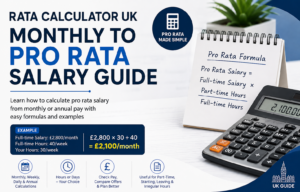
Pro Rata Salary = Full-Time Salary × (Hours or Days Worked ÷ Full-Time Hours or Days)
So if the full-time role is based on a 37.5-hour week and you work 22.5 hours:
£30,000 × (22.5 ÷ 37.5) = £18,000
Using Days Instead of Hours
If your contract is structured around days rather than hours (common in schools, retail, and admin roles), the same logic applies:
£30,000 × (3 ÷ 5) = £18,000
Both methods give the same result when the working pattern is consistent, but you should always use whichever unit matches your actual contract — mixing hours and days can produce an incorrect figure.
How Overtime Pay Works Pro Rata
This is where most people get confused, because overtime isn’t simply “extra hours at the same rate.” Here’s how it typically breaks down.
Standard Overtime Calculation
Overtime is usually paid at your normal hourly rate, or at a premium rate (time-and-a-half, double time) if that’s specified in your contract. To calculate it:
- Work out your normal hourly rate from your pro rata salary.
- Multiply that hourly rate by the overtime hours worked.
- Apply any overtime premium your employer offers (this isn’t a legal requirement in the UK — it’s contractual).
Example:
- Pro rata salary: £18,000 for 22.5 hours/week
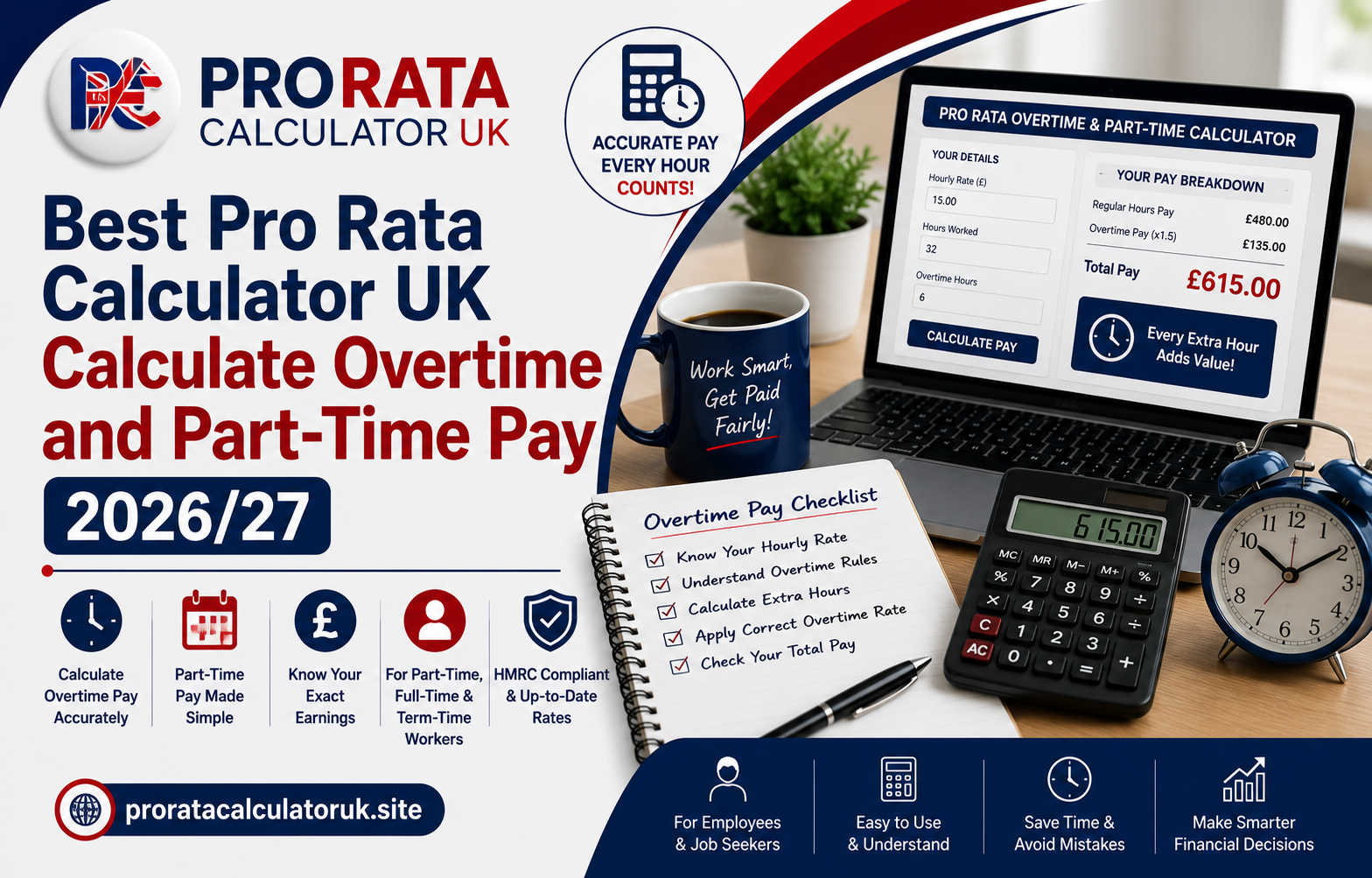
- Hourly rate: £18,000 ÷ (22.5 × 52) = £15.38/hour
- Overtime worked: 5 hours at time-and-a-half
- Overtime pay: 5 × £15.38 × 1.5 = £115.35
Important Legal Note
UK employers are not legally required to pay a premium for overtime unless it’s in your contract. However, your average pay (including overtime) must still meet or exceed the National Minimum Wage / National Living Wage across the hours actually worked. This is a common area where part-time and casual workers get shortchanged without realising it.
Read More: Pro Rata Calculator UK-Best Pension Contributions Guide (2026)
Part-Time Pay: What You Actually Take Home
Part-time pay calculations go beyond the basic pro rata formula once tax, National Insurance, and pension contributions come into play.
| Factor | How It’s Calculated |
|---|---|
| Gross pro rata salary | FTE Salary × (Your hours ÷ Full-time hours) |
| Personal Allowance | £12,570 tax-free (2025/26), applied in full regardless of part-time status |
| Income Tax | 20% on earnings above allowance up to £50,270; 40% above that |
| National Insurance | Applied only above the relevant threshold, same rates as full-time staff |
| Pension contributions | Usually a % of pro rata salary, not full-time salary |
A key point many part-time workers miss: your full Personal Allowance applies even if you work part-time. This often means part-time workers pay proportionally less tax than they expect, since a bigger share of a smaller salary falls within the tax-free band.
Why Job Adverts List the Full-Time Equivalent Salary
Almost every UK job advert quotes a Full-Time Equivalent (FTE) salary, even for roles that are explicitly part-time. This trips up a lot of candidates who assume the advertised figure is what they’ll actually be paid.
Employers do this for a few practical reasons:
- Consistency across the organisation. It lets HR compare pay bands fairly across full-time and part-time staff in the same role.
- Pay scale alignment. Public sector jobs (NHS, education, local government) almost always use banded FTE salaries, then apply the pro rata reduction based on contracted hours.
- Future flexibility. If your hours increase later, your salary scales up from the same FTE baseline rather than needing a new contract negotiated from scratch.
When you see a salary listed as “£28,000 FTE, pro rata,” that means £28,000 is the full-time figure, and your actual pay depends entirely on your contracted hours. Always ask for the pro rata figure directly during the interview stage — recruiters expect this question, and it avoids awkward surprises later.
Read More: Pro Rata Calculator UK-Best Bank Holiday EntitlementPro Rata Pay for Casual, Zero-Hours, and Irregular Workers
Not everyone works fixed part-time hours. Zero-hours contracts, casual work, and irregular shift patterns need a slightly different approach because there’s no consistent weekly hours figure to plug into the standard formula.
For these workers, UK guidance (particularly following the Harpur Trust v Brazel Supreme Court ruling) recommends calculating holiday pay and entitlement using a 12.07% accrual method rather than a fixed weekly fraction:
Holiday Pay = Hours Worked × 12.07%
This percentage comes from dividing the statutory 5.6 weeks of holiday by the 46.4 working weeks in a year (52 weeks minus 5.6 weeks holiday). It gives an accurate accrual rate regardless of how irregular the hours are.
Example: If you work 15 hours in a given week on a zero-hours contract:
15 × 12.07% = 1.81 hours of paid holiday accrued for that week
This method is fairer for genuinely irregular workers than trying to force a flat weekly pro rata figure onto hours that change constantly.
Statutory Sick Pay and Pro Rata Workers
Statutory Sick Pay (SSP) works differently to salary and holiday pay — it isn’t calculated pro rata in the same proportional sense, but your eligibility and average weekly earnings still depend on your actual pattern of work.
Key points part-time and pro rata workers should know:
- SSP is a flat weekly rate, not scaled by hours — but you must earn above the Lower Earnings Limit on average to qualify at all.
- Your average weekly earnings are calculated using your actual (pro rata) pay, not the full-time equivalent salary.
- Part-time workers on low hours sometimes fall below the earnings threshold and don’t qualify for SSP, which is worth checking before assuming you’re covered.
Redundancy Pay and Pro Rata Calculations
If a part-time role is made redundant, statutory redundancy pay is also calculated using your actual pro rata pay, not the FTE salary. The calculation uses:
- Age
- Length of continuous service
- Weekly pay (capped at a statutory maximum, which changes each tax year)
Because “weekly pay” here means your actual pro rata weekly earnings, part-time workers with long service can sometimes end up with a redundancy figure that looks smaller than expected purely because the salary base is smaller — length of service is what protects your entitlement, not the FTE headline figure.
Pro Rata Holiday Entitlement
Holiday entitlement is also calculated pro rata, based on the statutory minimum of 5.6 weeks (28 days for a full-time worker under the Working Time Regulations 1998).
Formula:
Holiday Entitlement = 5.6 × Number of Days Worked Per Week
Example: If you work 3 days a week:
5.6 × 3 = 16.8 days of paid holiday per year
For term-time or irregular-hours workers, the calculation changes slightly — HMRC and ACAS now recommend using 12.07% of hours worked as an accrual rate rather than a flat weekly figure, particularly since the Harpur Trust v Brazel ruling affected how holiday pay is calculated for workers without fixed hours.
Read More: Pro Rata Calculator UK-Best Pro Rata SalaryStep-by-Step: How to Use a Pro Rata Calculator UK Tool
- Enter the full-time equivalent salary — this is the FTE figure, usually listed in the job advert or contract.
- Enter your actual hours or days worked — be precise; contracts sometimes round hours in ways that affect the result.
- Add any overtime hours separately — most calculators let you input these as a distinct field rather than folding them into your base hours.
- Check the output against your payslip — small discrepancies often point to pension deductions, tax code issues, or an incorrect FTE baseline.
- Recalculate whenever your hours change — a change in contracted hours mid-year also affects your pro rata holiday and pension figures, not just your salary.
Pro Rata vs Full-Time Pay: Quick Comparison
| Full-Time | Pro Rata (Part-Time) | |
|---|---|---|
| Salary basis | Full annual salary | Scaled to hours/days worked |
| Personal Allowance | £12,570 | Same £12,570, full amount |
| Holiday entitlement | 28 days (5.6 weeks) | Scaled by days worked per week |
| Overtime | Rare, often salaried | More common, hourly-based |
| Pension contribution | % of full salary | % of pro rata salary |
Pro Rata Pay When You Change Roles Mid-Year
Switching from full-time to part-time (or the reverse) partway through the tax year is another common situation that trips people up. Your annual pay isn’t simply a straight-line split between the two periods — payroll systems typically calculate it in stages:
- Stage 1: Full-time salary applies up to the date the change takes effect.
- Stage 2: Pro rata salary applies from the change date to the end of the tax year, based on your new hours.
- Tax and NI: These are recalculated cumulatively across the whole year, so a mid-year change can temporarily shift your tax code or produce a small over/underpayment that corrects itself by the following payslip or at year-end.
If you’re planning a change in hours, ask your employer or payroll team for a projected figure rather than assuming last year’s P60 gives you an accurate picture — it won’t reflect the new pattern.
Common Mistakes People Make With Pro Rata Pay
- Confusing hours-based and days-based contracts. These can give slightly different results if your working pattern is irregular.
- Forgetting overtime isn’t automatically premium-rate. Check your contract — it’s not a legal default.
- Assuming holiday entitlement is a flat number. It should scale with your actual working pattern, not just be a percentage of 28 days without checking hours.
- Using outdated tax bands. Always check you’re using the current tax year’s Personal Allowance and NI thresholds.
- Ignoring term-time adjustments. Term-time-only workers need a different formula that accounts for unpaid weeks.
What does “pro rata” mean for salary?
It means your pay is proportioned to match the hours or days you actually work, compared to a full-time role.
How do I calculate pro rata salary from an annual figure?
Multiply the full-time salary by your hours (or days) worked, divided by the full-time hours (or days).
Is overtime included in pro rata pay?
Not automatically. Overtime is usually calculated separately and added on top of your base pro rata salary.
Do part-time workers get the full tax-free Personal Allowance?
Yes. The £12,570 Personal Allowance applies in full, regardless of how many hours you work.
How is pro rata holiday entitlement calculated?
Multiply 5.6 (the statutory holiday week entitlement) by the number of days you work per week.
Are employers legally required to pay overtime at a higher rate?
No. Premium overtime rates are contractual, not a legal requirement, though average pay must still meet minimum wage law.
What’s the difference between pro rata by hours and pro rata by days?
Hours-based calculations use your weekly hours compared to full-time hours; days-based calculations compare working days instead. Use whichever matches your contract.
How does pro rata pay affect pension contributions?
Pension contributions are usually calculated as a percentage of your pro rata salary, not the full-time equivalent.
Does pro rata pay change if my hours change mid-year?
Yes. Your salary, holiday entitlement, and pension contributions should all be recalculated whenever your contracted hours change.
Can a pro rata calculator be used for term-time-only contracts?
Yes, but it needs a modified formula that accounts for unpaid weeks — a standard weekly pro rata formula alone isn’t accurate for term-time roles.
Is redundancy pay calculated on FTE salary or pro rata salary?
Statutory redundancy pay uses your actual pro rata weekly pay, not the full-time equivalent figure, alongside your age and length of service.
Does Statutory Sick Pay scale with my pro rata hours?
No. SSP is a flat weekly rate, but you must earn above the Lower Earnings Limit based on your actual average pay to qualify for it at all.
Negotiating Pro Rata Pay-What to Check Before You Accept
If you’re offered a part-time role advertised at an FTE salary, a few checks before you sign the contract can save you confusion later:
- Confirm whether the FTE figure includes any London weighting or regional allowance, since these are sometimes quoted separately and can change your actual pro rata result.
- Ask whether overtime is paid at your base pro rata rate or a premium rate, and get it in writing rather than relying on a verbal answer.
- Check how your hours are averaged if your shifts vary week to week — some contracts use an annualised hours model instead of a fixed weekly figure, which changes how pro rata pay is worked out.
- Clarify whether pension auto-enrolment is based on your pro rata salary or a banded qualifying earnings figure, since UK auto-enrolment rules use specific earnings thresholds that don’t always scale simply with hours.
None of this is complicated once you know what to ask, but it’s exactly the kind of detail that gets glossed over in a verbal job offer and only becomes clear once you’re already three months into the role.
Final Thoughts
Pro rata pay isn’t complicated once you understand the core formula, but the details around overtime, tax allowances, and holiday entitlement are where most confusion happens. Using a Pro Rata Calculator UK tool takes care of the maths, but understanding what’s actually being calculated means you can spot errors on your payslip before they become a problem. Whether you’re negotiating a part-time role, calculating overtime, or checking your holiday entitlement, knowing these formulas puts you in control of your own numbers.