You’ve seen the job advert. It says £32,000, but underneath in smaller text it says “pro rata.” Suddenly that number isn’t what you thought it was, and you’re left doing mental maths in an interview you didn’t prepare for. This confusion is exactly why a Rata Calculator UK tool exists — to turn a full-time salary figure into the real number that actually lands in your bank account each month.
This guide breaks down exactly how pro rata and full-time salaries differ, where the confusion usually starts, and how to work out your true earnings whether you’re moving to part-time work, negotiating a new contract, or just trying to understand a job offer properly.
What “Pro Rata” Actually Means
“Pro rata” is a Latin phrase meaning “in proportion.” When it’s attached to a salary, it simply means the full-time figure has been scaled down to match the hours or days you actually work.
It isn’t a different pay structure, a lower salary band, or a penalty for working part-time. It’s the same salary, proportioned fairly.
Here’s the distinction that trips most people up:
- Full-time salary = the amount paid for a standard full working week (usually 35–40 hours, depending on the employer).
- Pro rata salary = the same salary scaled down based on the actual hours or days you’re contracted to work.
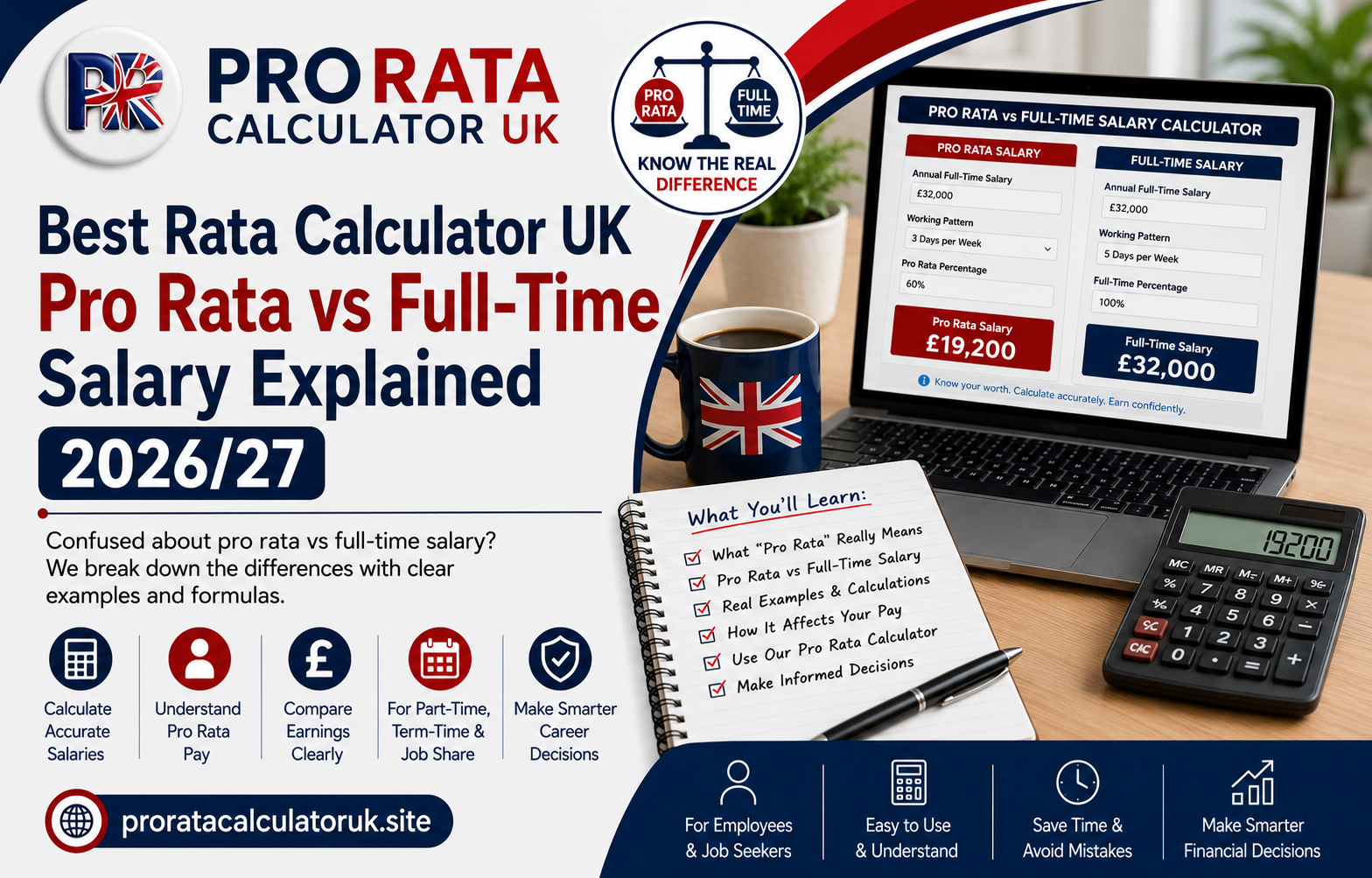
If a role is listed at £32,000 full-time and you work 3 days out of a standard 5-day week, your pro rata salary isn’t £32,000. It’s £32,000 scaled to 3/5ths.
Visit Now: MauricetteCalculetteThe Core Formula: Pro Rata vs Full-Time Salary
UK employers and payroll teams use one standard formula to convert a full-time salary into a pro rata figure:
Pro Rata Salary = Full-Time Salary × (Hours or Days Worked ÷ Full-Time Hours or Days)
Worked Example Using Days
Full-time salary: £32,000. Full-time working pattern: 5 days a week. Your working pattern: 3 days a week
£32,000 × (3 ÷ 5) = £19,200
Worked Example Using Hours
Full-time salary: £32,000 Full-time hours: 37.5 hours a week Your hours: 22.5 hours a week
£32,000 × (22.5 ÷ 37.5) = £19,200
Both methods give the same answer here because the working pattern is consistent. Where they diverge is when your contract specifies irregular hours that don’t map neatly onto a simple day fraction — in that case, always calculate using hours rather than days, since it’s more precise.
Full-Time vs Pro Rata Salary: Side-by-Side Comparison
| Factor | Full-Time Salary | Pro Rata Salary |
|---|---|---|
| Basis | Paid for standard full week (e.g. 37.5 hrs) | Scaled to actual hours/days worked |
| Personal Allowance | £12,570 tax-free (2025/26) | Same £12,570 — doesn’t reduce with hours |
| Holiday entitlement | 28 days (5.6 weeks) | Scaled by days worked per week |
| Pension contributions | % of full salary | % of pro rata salary |
| Overtime | Less common, often salaried | More common, usually hourly |
| Sick pay eligibility | Standard SSP rules apply | Same rules, but must meet earnings threshold |
Why the Confusion Happens So Often
Most confusion around pro rata vs full-time salary comes down to three things.
1. Job Adverts List the Full-Time Figure by Default
Recruiters advertise the FTE (Full-Time Equivalent) salary because it’s the standard reference point across the organisation, even for roles that are explicitly part-time. This isn’t misleading on purpose — it’s just industry convention — but it means candidates need to ask directly for the pro rata figure rather than assuming the advertised number is what they’ll receive.
2. People Assume Tax Scales the Same Way as Salary
This is a common misunderstanding. Many part-time workers assume that because their salary is lower, their tax-free allowance must also be lower. It isn’t. The full £12,570 Personal Allowance (2025/26) applies regardless of your hours, which often means a larger proportion of a smaller pro rata salary ends up tax-free compared to a full-time salary.
3. Contracts Mix Hours and Days Inconsistently
Some contracts specify hours per week, others specify days, and a few specify both in a way that doesn’t match cleanly. If your contract says “3 days, up to 22 hours,” you need to know which figure your employer actually uses for pro rata calculations — this should always be clarified in writing before you accept a role.
How Pro Rata Affects Other Areas of Pay
Salary isn’t the only thing calculated pro rata. A few other areas commonly get scaled the same way, and it’s worth understanding each one separately.
Holiday Entitlement
Statutory holiday entitlement is 5.6 weeks a year for a full-time worker (28 days based on a 5-day week). For part-time workers, this scales down:
Holiday Entitlement = 5.6 × Days Worked Per Week
Someone working 3 days a week gets 5.6 × 3 = 16.8 days of paid holiday a year.
Pension Contributions
Workplace pension contributions under auto-enrolment are usually calculated as a percentage of qualifying earnings, based on your actual pro rata salary — not the full-time equivalent. This means your pension contributions will be proportionally lower on a part-time salary, which is worth factoring into long-term retirement planning if you’re considering reduced hours.
Sick Pay
Statutory Sick Pay (SSP) is a flat weekly rate rather than something scaled pro rata, but you must earn above the Lower Earnings Limit on average to qualify. Part-time workers on very low hours sometimes fall below this threshold and don’t qualify for SSP at all, which catches people out if they assume all employees are automatically covered.
Redundancy Pay
Statutory redundancy pay uses your actual pro rata weekly pay (not the FTE salary), combined with your age and length of continuous service. This means two employees with the same job title and the same years of service can receive different redundancy amounts if one works full-time and the other part-time.
Read More: Rata Calculator UK for EmployeesStep-by-Step: Using a Rata Calculator UK Tool to Work Out Your Pro Rata Salary
- Find the full-time salary figure. This is usually the number in the job advert, sometimes labelled “FTE.”
- Confirm the full-time hours or days. Ask what a “full week” means at that specific employer — it’s not always 40 hours or 5 days.
- Confirm your own contracted hours or days. Use the exact figure in your contract, not a rough estimate.
- Apply the formula. Full-Time Salary × (Your Hours or Days ÷ Full-Time Hours or Days).
- Cross-check with a pro rata calculator. A calculator removes the risk of manual arithmetic errors, especially with irregular hours like 22.5 or 27.75.
- Ask HR to confirm the figure in writing. This protects you if there’s a mismatch between what you calculated and what appears on your first payslip.
Read More: Rata Calculator UK-Ultimate Pro Rata Pay GuidePro Rata Salary for Term-Time and Irregular Workers
Standard weekly pro rata formulas don’t work well for term-time roles (such as school-based positions) because these workers aren’t paid for the weeks they don’t work.
For term-time contracts, the more accurate formula is:
Pro Rata Salary = Annual Salary × (Term Weeks + Holiday Weeks) ÷ 52.143
This accounts for the fact that a term-time worker’s pay needs to reflect both the weeks they actually work and their proportion of paid holiday, rather than assuming a full 52-week year like a standard part-time role.
For zero-hours or genuinely irregular contracts, holiday pay is usually calculated using a 12.07% accrual rate applied to hours actually worked, following guidance shaped by the Harpur Trust v Brazel ruling — a flat weekly pro rata fraction doesn’t work when hours vary from week to week.
Pro Rata Salary and Career Progression
One thing rarely mentioned in job adverts: how pro rata salary interacts with pay rises, promotions, and pay bands over time. This matters more than most part-time workers realise.
- Annual pay rises apply to the FTE figure first. If your employer gives everyone a 4% increase, that percentage is applied to the full-time equivalent salary, then your pro rata figure is recalculated from the new baseline — not from your existing pro rata number directly. In practice,e the result is the same, but understanding this helps you check your payslip is correct after a pay review.
- Pay band progression works identically to full-time staff. If a role has salary bands (common in the NHS, education, and local government), moving up a band affects your FTE salary first, and your pro rata pay is scaled from that new figure.
- Increasing your hours later doesn’t require a new contract in most cases. Since your pay is already tied to an FTE baseline, most employers simply adjust the pro rata fraction if you move from, say, 3 days to 4 days a week.
This is one of the practical advantages of pro rata pay structures — they scale predictably, which makes it easier to plan if you expect your hours to change.
Pro Rata Salary vs Hourly Rate: Which Should You Compare?
Some job seekers compare offers using hourly rate instead of pro rata annual salary, and both approaches have their place depending on what you’re trying to work out.
| Comparison Method | Best Used When |
|---|---|
| Pro rata annual salary | Comparing two part-time roles with similar working patterns |
| Hourly rate | Comparing roles with very different hours or day patterns |
| Full-time equivalent salary | Comparing career progression and pay band potential |
To convert a pro rata salary into an hourly rate:
Hourly Rate = Pro Rata Salary ÷ (Weekly Hours × 52)
Example: £19,200 pro rata salary, 22.5 hours a week:
£19,200 ÷ (22.5 × 52) = £16.41 per hour
This figure is useful when comparing a salaried part-time role against freelance or contract work quoted at an hourly rate, since it gives you a direct like-for-like comparison rather than trying to compare two very different pay structures.
Read More: Rata Calculator UK-Essential Guide to Easily CalculateWhat Happens If You Switch Between Full-Time and Part-Time Mid-Year
Moving from full-time to part-time (or the other way round) partway through a tax year is more common than people expect, and it raises a specific question: how is the year’s pay actually split?
In practice, payroll systems handle this in two stages rather than blending the figures:
- Before the change: You’re paid the full-time salary up until the exact date your new working pattern starts.
- After the change: Your pro rata salary applies from that date onward, based on your new hours or days.
Tax and National Insurance are calculated cumulatively across the whole tax year, so a mid-year switch can temporarily affect your tax code or produce a small adjustment on your next payslip that corrects itself automatically. If you’re planning a switch, it’s worth asking payroll for a projected annual figure rather than assuming a simple average between your old and new salary — the actual calculation is date-based, not a straight blend.
This is also the point where holiday entitlement and pension contributions need recalculating, since both are tied to your current working pattern rather than an average across the year.
Common Mistakes When Comparing Pro Rata and Full-Time Pay
- Assuming pro rata means a pay cut. It’s the same salary rate, just proportioned to fewer hours — the hourly or daily rate itself doesn’t change.
- Forgetting to check which “week” the employer uses. A 35-hour full-time week and a 40-hour full-time week produce different pro rata results from the same salary.
- Mixing up gross and net figures. A pro rata calculator gives gross pay; your actual take-home depends on tax code, pension contributions, and any salary sacrifice arrangements.
- Not accounting for London weighting separately. If your FTE salary includes a location allowance, make sure it’s being scaled correctly rather than added on top after the pro rata calculation.
- Assuming annual leave stays the same when hours change. Holiday entitlement should be recalculated whenever your contracted hours change mid-year.
What does pro rata mean compared to full-time salary?
Pro rata means the full-time salary figure has been scaled down proportionally to match the hours or days you actually work — it’s the same pay rate, not a reduced one.
How do I calculate my pro rata salary from a full-time figure?
Multiply the full-time salary by your hours (or days) worked, divided by the full-time hours (or days) for that role.
Does pro rata pay mean I earn less per hour than a full-time employee?
No. Your hourly or daily rate stays the same — only the total annual figure changes to reflect fewer hours worked.
Do part-time workers get the full tax-free Personal Allowance?
Yes. The £12,570 Personal Allowance (2025/26) applies in full, regardless of how many hours you work.
Is holiday entitlement the same for pro rata and full-time staff?
No, holiday entitlement scales with the days you work per week, calculated as 5.6 × your working days per week.
How is pro rata salary different for term-time workers?
Term-time pro rata pay uses a formula based on term weeks plus holiday weeks divided by 52.143, rather than a standard weekly fraction, since term-time staff isn’t paid for unworked weeks.
Does my pension contribution stay the same on a pro rata salary?
No. Pension contributions are usually a percentage of your pro rata salary, not the full-time equivalent, so contributions are proportionally lower.
Can I negotiate a pro rata salary the same way as a full-time salary?
Yes. Since the pro rata figure comes from the same FTE baseline, negotiating the full-time equivalent salary directly affects your actual pro rata pay.
Why do job adverts list the full-time salary instead of the pro rata figure?
It’s industry convention, mainly for internal consistency across pay bands — always ask for the pro rata figure directly if the role is part-time.
Is redundancy pay based on my pro rata salary or my full-time equivalent?
Statutory redundancy pay uses your actual pro rata weekly pay, combined with your age and length of service, not the FTE salary.
Final Thoughts
Pro rata and full-time salary aren’t two different pay systems — they’re the same underlying rate applied differently depending on how many hours you work. Once you understand the formula and know which figures to ask for, there’s no reason a “pro rata” label on a job advert should cause any confusion. The rate itself never changes; only the proportion of a full-time week you’re being paid for does.
Whether you’re comparing offers, negotiating hours, switching from full-time to part-time, or just double-checking your first payslip, using a Rata Calculator UK tool alongside the formulas in this guide gives you an accurate, reliable way to know exactly what you’re being paid — and why. Keep the core formula in mind, check it against your contract’s actual working pattern, and you’ll never be caught off guard by a pro rata figure again.