Imagine you’ve just received some good news at work. Your employer announces a company-wide salary increase, or perhaps you’ve earned a well-deserved pay rise after your annual review. Naturally, one of the first questions that comes to mind is, “How much more will I actually earn?”
For full-time employees, the answer is often straightforward. However, if you work part-time, on a job-share arrangement, or during school terms only, calculating your new salary can quickly become confusing. You may wonder whether your increase applies in full, how your reduced hours affect the calculation, or whether your monthly pay will change immediately.
This is where a Rata Calculator UK becomes useful. Instead of estimating your earnings or relying on complicated spreadsheets, you can calculate your updated salary based on your contracted hours and your employer’s new full-time salary.
In this guide, you’ll learn exactly how pro rata pay changes after a salary increase, how employers calculate your new earnings, what information you need before using a calculator, and how to avoid common mistakes that can lead to inaccurate results.
Whether you’re a part-time employee, a teacher on a term-time contract, a job-share worker, or someone returning to flexible working, this guide will help you understand your updated pay with confidence.
What Is Pro Rata Pay?
Pro Rata Meaning in the UK
The term pro rata comes from Latin and simply means “in proportion.”
In UK employment, pro rata pay means an employee receives salary, benefits, holiday entitlement, or other employment-related payments based on the proportion of hours or time they actually work compared with a full-time employee.
For example, if a full-time employee works 37.5 hours per week and earns £36,000 per year, someone working 18.75 hours per week (half the hours) would normally receive approximately £18,000 per year, assuming the same role and pay rate.
The principle ensures that employees working fewer contracted hours are paid fairly for the proportion of work they perform.
Visit Now: MauricetteCalculetteHow Pro Rata Pay Works
Pro rata calculations compare your contracted working hours with the employer’s standard full-time hours.
The basic process is simple:
- Identify the full-time annual salary.
- Determine the full-time weekly hours.
- Calculate what percentage of those hours you work.
- Apply that percentage to the full-time salary.
For example:
| Full-Time Salary | Full-Time Hours | Your Hours | Working Percentage | Pro Rata Salary |
|---|---|---|---|---|
| £40,000 | 40 hours | 20 hours | 50% | £20,000 |
| £40,000 | 40 hours | 30 hours | 75% | £30,000 |
| £40,000 | 40 hours | 35 hours | 87.5% | £35,000 |
Although the calculation is straightforward, many employees become confused when pay rises, promotions occur, or working hours change at different points during the year.
When Employers Use Pro Rata Salaries
Employers commonly apply pro rata calculations whenever an employee works less than the standard full-time schedule.
Typical examples include:
- Part-time employees
- Job-share arrangements
- School term-time staff
- Flexible working contracts
- Employees returning from maternity or paternity leave on reduced hours
- Phased retirement arrangements
- Employees who start or leave a job partway through the year
In each case, the employee’s pay is adjusted according to the proportion of paid hours they work.
Read More: Ultimate Rata Calculator UK Guide 2026/27-What Does Pro Rata Mean?Difference Between Pro Rata Pay and Full-Time Salary
Many people assume a pro rata salary is simply a lower salary. In reality, it represents the same pay rate adjusted for fewer contracted hours.
Here’s a simple comparison:
| Full-Time Salary | Pro Rata Salary |
|---|---|
| Based on standard full-time hours | Based on contracted hours worked |
| Employee works all contracted full-time hours | Employee works fewer hours |
| Receives full annual salary | Receives proportional annual salary |
| Often 35–40 hours per week | Can be any agreed number of hours |
Understanding this distinction is especially important when your employer announces a salary increase.
What Happens to Pro Rata Pay After a Salary Increase?
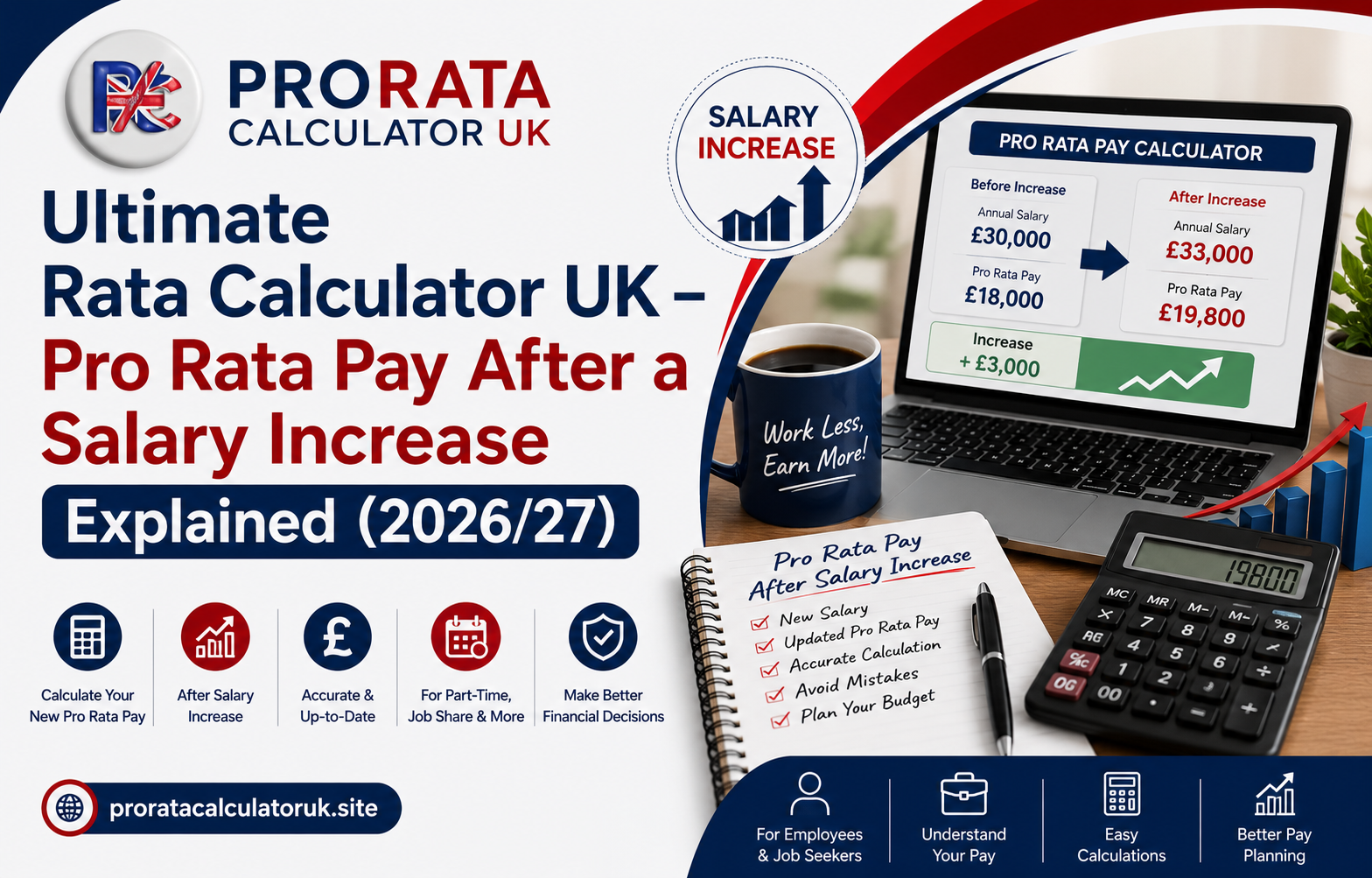
Receiving a pay rise doesn’t change the way pro rata pay is calculated. Instead, your employer updates the full-time salary first, then applies the same proportional calculation based on your contracted hours.
If your hours remain unchanged, your working percentage also remains the same. The only difference is that it is applied to the new salary.
How a Salary Increase Changes Pro Rata Earnings
Suppose a company increases the annual full-time salary from £32,000 to £34,000.
An employee working exactly half the standard hours would see their salary change like this:
| Before Increase | After Increase |
|---|---|
| £16,000 | £17,000 |
The increase is proportional because the employee continues working 50% of full-time hours.
Why Part-Time Employees Receive Pro Rata Pay Rises
A salary increase generally applies to eligible part-time employees in the same way it applies to full-time employees. The difference is simply the number of contracted hours used in the calculation.
For example, if every employee receives a 5% salary increase, a part-time employee also benefits from the same percentage increase.
The actual monetary amount will be smaller because it is calculated on a lower pro rata salary, not because the employee receives a smaller percentage increase.
Does Every Salary Increase Apply Pro Rata?
Not always.
Whether a pay rise applies depends on factors such as:
- Your employment contract
- Company pay review policies
- Collective bargaining agreements
- Promotion arrangements
- Performance-based salary reviews
- Eligibility dates
- Temporary contracts
For example, if a salary increase becomes effective after you leave the company or before your probation period ends, you may not qualify.
Always check your employer’s written confirmation of the salary increase.
Read More: Best Rata Calculator UK – Calculate Annual Leave on a Pro Rata Basis (2026/27)
Common Workplace Scenarios
Salary increases don’t always happen under identical circumstances. Here are a few examples where pro rata calculations may differ:
Annual Pay Review
Many UK employers review salaries once each year. If your employer announces a company-wide increase, your updated pro rata salary is usually calculated from the effective date.
Promotion
If you’re promoted while remaining part-time, your new salary is generally based on the higher full-time salary for your new role before applying the pro rata calculation.
Reduced Working Hours
Sometimes an employee receives a salary increase while also reducing their working hours. In this case, both the salary and the percentage of working hours change, making the calculation more complex.
Mid-Year Salary Increase
If your salary changes halfway through the financial year, your employer may calculate part of your annual pay using the old salary and the remainder using the new salary.
This is one of the most common situations where employees use a Rata Calculator UK to estimate their updated earnings before receiving their next payslip.
How a Rata Calculator UK Calculates Your New Pay
A Rata Calculator UK simplifies what could otherwise be several manual calculations. Instead of working through formulas yourself, you enter a few key details and the calculator estimates your updated salary across different pay periods.
Before using the calculator, gather the following information:
Current Salary
Your existing full-time or pro rata annual salary before the increase.
New Full-Time Salary
The updated annual salary offered for the full-time position after the pay rise.
Hours Worked Per Week
Your contracted paid working hours.
Only include hours that are paid under your employment contract.
Full-Time Weekly Hours
Your employer’s standard full-time working week.
Remember that not every organisation uses a 40-hour week. Many UK employers operate on:
- 35 hours
- 37 hours
- 37.5 hours
- 38 hours
- 39 hours
Using the wrong figure can lead to inaccurate results.
Pro Rata Pay Formula
The standard formula is:
Pro Rata Salary = Full-Time Salary × (Your Weekly Hours ÷ Full-Time Weekly Hours)
For example:
- Full-time salary: £42,000
- Full-time hours: 37.5
- Your hours: 25
Calculation:
£42,000 × (25 ÷ 37.5) = £28,000
This proportional approach ensures your salary reflects both the updated pay rate and your contracted hours.
How the Calculation Works Step by Step
A typical Rata Calculator UK follows this process:
- Records the updated full-time annual salary.
- Identifies the employer’s standard weekly hours.
- Calculates your working-hour percentage.
- Applies the pro rata formula.
- Converts the annual result into monthly, weekly, daily, or hourly figures where required.
By automating these steps, the calculator reduces the risk of manual errors and gives you a clearer picture of how a salary increase affects your earnings.
Excellent. This is Part 2, which contains the core value of the article. It follows your website’s writing style with practical calculations, clear formulas, and real UK workplace scenarios.
Step-by-Step: Calculate Pro Rata Pay After a Salary Increase
Once your employer confirms a salary increase, calculating your updated pay is easier than many people expect. The key is to use your employer’s new full-time salary together with your contracted working hours.
Whether you’re checking your next payslip or planning your finances, following these steps will help you estimate your new earnings accurately.
Step 1 – Find the New Full-Time Salary
Start with the new annual salary for a full-time employee in your role.
This figure is usually provided in:
- A salary review letter
- A promotion letter
- An HR email
- Your employment contract amendment
- A company-wide pay review announcement
For example:
| Before Pay Rise | After Pay Rise |
|---|---|
| £34,000 | £36,000 |
Even if you work part-time, always begin with the full-time salary.
Important: Do not use your old pro rata salary as the starting point unless your employer has already confirmed your updated pro rata amount.
Step 2 – Calculate Your Working Hour Percentage
Next, work out what percentage of the full-time schedule you work.
Formula
Working Percentage = Your Weekly Hours ÷ Full-Time Weekly Hours
Example:
- Your contracted hours: 24
- Full-time hours: 37.5
Calculation:
24 ÷ 37.5 = 0.64
Working percentage:
64%
This percentage stays the same unless your contracted hours also change.
Step 3 – Apply the Pro Rata Formula
Now calculate your updated annual salary.
Formula
Pro Rata Salary = New Full-Time Salary × Working Percentage
Example
- Full-time salary: £36,000
- Working percentage: 64%
Calculation:
£36,000 × 0.64 = £23,040
Your updated annual salary becomes £23,040.
Step 4 – Calculate Your New Annual Salary
Once you’ve calculated the annual amount, compare it with your previous salary.
| Before Increase | After Increase |
|---|---|
| £21,760 | £23,040 |
Difference:
£1,280 per year
Breaking the increase down like this helps you understand the real financial impact of your pay rise.
Step 5 – Estimate Monthly, Weekly and Hourly Pay
Most people receive monthly or weekly pay rather than an annual salary.
You can convert your annual salary into other pay periods.
| Pay Period | Formula |
|---|---|
| Monthly | Annual Salary ÷ 12 |
| Weekly | Annual Salary ÷ 52 |
| Daily | Weekly Pay ÷ Paid Working Days |
| Hourly | Weekly Pay ÷ Weekly Hours |
Example:
Annual salary:
£23,040
| Pay Period | Amount |
|---|---|
| Monthly | £1,920.00 |
| Weekly | £443.08 |
| Hourly (24 hrs/week) | £18.46 |
These figures may differ slightly depending on payroll rounding and your employer’s pay schedule.
Real-Life Pro Rata Salary Increase Examples
The following examples show how a Rata Calculator UK works in different situations.
Example 1: Employee Working 20 Hours Per Week
Situation
- Full-time salary before increase: £32,000
- New full-time salary: £34,000
- Full-time hours: 40
- Employee works: 20 hours
Working percentage:
20 ÷ 40 = 50%
Calculation:
£34,000 × 50%
= £17,000
| Before | After |
|---|---|
| £16,000 | £17,000 |
Annual increase:
£1,000
Example 2: Employee Working 25 Hours Per Week
Situation
- New full-time salary: £39,000
- Full-time hours: 37.5
- Employee works: 25 hours
Working percentage:
25 ÷ 37.5
= 66.67%
Calculation:
£39,000 × 66.67%
≈ £26,000
Estimated monthly salary:
£2,166.67
Example 3: Employee Working 30 Hours Per Week
Situation
- Full-time salary: £42,000
- Full-time hours: 37.5
- Employee works: 30 hours
Working percentage:
30 ÷ 37.5
= 80%
Calculation:
£42,000 × 80%
= £33,600
| Annual | Monthly | Weekly |
|---|---|---|
| £33,600 | £2,800 | £646.15 |
Example 4: School Term-Time Employee
Many school support staff do not work the entire year.
Suppose:
- Full-time salary: £31,000
- Employee works 25 hours per week
- Contract covers 39 weeks each year
The employer first calculates the pro rata salary based on working hours and then adjusts it to reflect the number of paid weeks.
This is why term-time salaries are often lower than standard part-time salaries, even when weekly hours are the same.
A Rata Calculator UK designed for education staff usually includes an option for paid weeks or term-time contracts.
Example 5: Mid-Year Salary Increase
Sometimes a salary increase takes effect halfway through the financial year.
Example:
January to June:
Annual salary:
£28,000
July to December:
Annual salary:
£30,000
Instead of receiving the higher salary for the entire year, your employer calculates:
- Six months at the old rate
- Six months at the new rate
This means your total annual earnings will fall somewhere between the two annual salaries.
Example 6: Promotion with Reduced Working Hours
A promotion doesn’t always mean working more hours.
Example:
Before promotion:
- Full-time equivalent salary: £38,000
- Employee works 30 hours
After promotion:
- New full-time salary: £45,000
- Employee reduces hours to 27
Calculation:
Working percentage:
27 ÷ 37.5
= 72%
New salary:
£45,000 × 72%
= £32,400
Although the employee reduced their hours, the higher salary for the promoted role still increased their overall earnings.
Pro Rata Pay Comparison Tables
Annual Salary Before vs After the Pay Rise
| Old Full-Time Salary | New Full-Time Salary | Working Hours | New Pro Rata Salary |
|---|---|---|---|
| £30,000 | £32,000 | 20 | £16,000 |
| £34,000 | £36,000 | 25 | £24,000 |
| £38,000 | £40,000 | 30 | £32,000 |
| £42,000 | £44,000 | 35 | £41,067* |
Assuming a 37.5-hour full-time week.
Monthly Pro Rata Salary Comparison
| Annual Salary | Monthly Pay |
|---|---|
| £18,000 | £1,500 |
| £22,000 | £1,833.33 |
| £26,000 | £2,166.67 |
| £30,000 | £2,500 |
| £34,000 | £2,833.33 |
Weekly Pro Rata Pay Comparison
| Annual Salary | Weekly Pay |
|---|---|
| £18,000 | £346.15 |
| £22,000 | £423.08 |
| £26,000 | £500.00 |
| £30,000 | £576.92 |
| £34,000 | £653.85 |
Hourly Rate Comparison
Assuming a 37.5-hour full-time week.
| Annual Salary | Hourly Rate |
|---|---|
| £28,000 | £14.36 |
| £32,000 | £16.41 |
| £36,000 | £18.46 |
| £40,000 | £20.51 |
| £44,000 | £22.56 |
Different Working Hours Comparison
Assuming:
- Full-time salary: £40,000
- Full-time week: 40 hours
| Weekly Hours | Working Percentage | Pro Rata Salary |
|---|---|---|
| 15 | 37.5% | £15,000 |
| 20 | 50% | £20,000 |
| 25 | 62.5% | £25,000 |
| 30 | 75% | £30,000 |
| 35 | 87.5% | £35,000 |
Quick Summary
When calculating pro rata pay after a salary increase, always:
- Start with the updated full-time salary.
- Use your contracted paid hours—not the hours you occasionally work.
- Check your employer’s standard full-time working week.
- Apply the pro rata formula before converting the result into monthly or weekly pay.
- Verify the final figure against your next payslip, especially if the increase takes effect partway through a pay period.
Factors That Affect Pro Rata Pay Calculations
Although the formula for pro rata pay is straightforward, several factors can influence the final amount you receive after a salary increase. Understanding these variables will help you interpret your payslip correctly and avoid unexpected differences between your estimate and your actual pay.
Number of Hours Worked
Your contracted paid hours are the most important factor in any pro rata calculation.
For example, if your employer’s full-time week is 37.5 hours:
| Weekly Hours | Working Percentage |
|---|---|
| 15 | 40% |
| 20 | 53.33% |
| 25 | 66.67% |
| 30 | 80% |
| 35 | 93.33% |
Even a small change in contracted hours can noticeably affect your annual salary.
Note: Always use your contracted paid hours rather than the hours you occasionally work due to overtime or shift swaps.
Full-Time Contracted Hours
Many employees assume a standard full-time week is 40 hours. In reality, this varies by employer.
Common UK full-time working patterns include:
- 35 hours
- 37 hours
- 37.5 hours
- 38 hours
- 39 hours
- 40 hours
Using the wrong full-time hours can produce an inaccurate pro rata salary.
Always check your employment contract or ask your HR department if you’re unsure.
Effective Date of the Salary Increase
A salary increase rarely applies to an entire tax year unless it starts on the first day of that year.
For example:
- Pay rise effective from 1 April
- Payroll processed on 25 April
- First increased salary received at the end of April
If your pay rise begins in the middle of a pay period, your payslip may contain:
- Pay at the previous salary
- Pay at the new salary
- A back payment (if applicable)
This often explains why the first payslip after a salary increase doesn’t match a simple annual calculation.
Pay Frequency
Your annual salary can be paid in different ways depending on your employer.
Common pay frequencies include:
- Weekly
- Fortnightly
- Every four weeks
- Monthly
The annual salary remains the same, but each payment amount differs according to the payroll schedule.
Overtime Payments
Overtime is usually calculated separately from your contracted salary.
Depending on your employer’s policy, overtime may be paid:
- At your standard hourly rate
- At time and a half
- At double time
- At enhanced rates for weekends or bank holidays
A salary increase may also increase your overtime rate if it is linked to your basic hourly pay.
Bonuses and Commission
Not every additional payment is calculated on a pro rata basis.
Examples include:
- Annual performance bonuses
- Sales commission
- Productivity incentives
- Attendance bonuses
Some bonuses are paid as a fixed amount, while others are based on your salary or working hours.
Check your employer’s bonus policy to understand how a salary increase affects these payments.
Pension Contributions
If you contribute to a workplace pension, your contributions may increase after a salary rise.
This is because pension deductions are often calculated as a percentage of pensionable earnings.
As your gross salary increases, both:
- Employee contributions
- Employer contributions
may also increase.
Holiday Pay
Holiday pay for part-time employees is generally calculated using the same pro rata principle as salary.
After a salary increase, your holiday pay may also increase because it reflects your updated rate of pay.
If your working hours remain unchanged, your holiday entitlement usually stays the same, but the value of each day’s leave may increase.
National Minimum Wage Compliance
Employers must ensure that your effective hourly pay continues to meet the applicable National Minimum Wage or National Living Wage requirements.
This is particularly important if:
- Your working hours change
- Your salary is reduced
- Salary sacrifice arrangements apply
If your calculated hourly rate falls below the legal minimum, your employer must adjust your pay accordingly.
Common Pro Rata Salary Increase Scenarios in the UK
Different workplace situations can affect how a salary increase is applied. Here are some of the most common examples.
Annual Pay Review
Many organisations review salaries once each year.
If everyone in your grade receives a 4% pay rise, your pro rata salary is normally increased by the same percentage.
The only difference is that the increase is applied to your pro rata salary rather than the full-time salary.
Inflation or Cost-of-Living Increase
Some employers award annual increases to help employees keep pace with rising living costs.
These increases usually apply equally to eligible full-time and part-time employees, with pro rata calculations ensuring that part-time staff receive a fair proportion based on their contracted hours.
Promotion
A promotion often changes both your salary and your responsibilities.
If you continue working the same number of hours, your new pro rata salary is calculated using the higher full-time salary for your new position.
If your hours also change, both factors must be included in the calculation.
Changing from Full-Time to Part-Time
Some employees reduce their working hours because of family commitments, education, or flexible working arrangements.
In this case:
- The employer determines the new full-time salary (including any pay rise).
- Your new working percentage is calculated.
- The updated pro rata salary is worked out using your revised hours.
Returning from Maternity or Paternity Leave
Many employees return on reduced hours after parental leave.
If a salary increase occurred during your absence and you’re eligible for it, your employer will normally calculate your updated salary using:
- The revised full-time salary
- Your agreed contracted hours after returning
Flexible Working Arrangements
Flexible working doesn’t always mean fewer hours.
Some employees compress full-time hours into fewer days, while others reduce their weekly hours.
Only a reduction in contracted paid hours affects the pro rata calculation.
Job Sharing
Job-share employees usually divide one full-time position between two people.
Each employee receives a salary based on:
- Their agreed hours
- Their share of the role
- The full-time salary attached to that position
If the full-time salary increases, both job-share employees receive proportional increases.
Common Mistakes When Calculating Pro Rata Pay
Even simple calculations can lead to incorrect results if the wrong information is used.
Here are the mistakes seen most often.
Using Calendar Hours Instead of Contracted Hours
Some employees include unpaid lunch breaks or occasional overtime in their calculations.
Always use contracted paid hours only.
Forgetting the Effective Date of the Pay Rise
A salary increase may not apply from the beginning of the month.
Ignoring the effective date can make your estimated annual salary higher than the amount shown on your next payslip.
Confusing Gross Pay with Net Pay
A pro rata calculator estimates gross salary.
Your take-home pay will usually be lower after deductions such as:
- Income Tax
- National Insurance
- Workplace pension contributions
- Student loan repayments (if applicable)
Ignoring Pension or Salary Sacrifice
Salary sacrifice arrangements can affect your gross pay before deductions.
Examples include:
- Additional pension contributions
- Cycle to Work schemes
- Electric vehicle salary sacrifice
- Childcare schemes (where available)
These arrangements can change the amount shown on your payslip even if your annual salary has increased.
Assuming Every Employee Has a 40-Hour Week
Many UK employers use a 37-hour or 37.5-hour working week.
Using a 40-hour assumption when your employer uses a different standard can significantly affect your calculated salary.
Tips for Getting Accurate Results with a Rata Calculator UK
A calculator is only as accurate as the information you enter. Following these best practices will help you get reliable results.
Check Your Employment Contract
Confirm:
- Your contracted weekly hours
- Your employment status
- Your standard working pattern
Use the Correct Full-Time Hours
Always use the full-time hours specified by your employer, not a general assumption.
Include Only Paid Hours
Exclude:
- Unpaid meal breaks
- Voluntary overtime
- Travel time (unless paid)
- Unpaid leave
Including unpaid hours can distort your calculation.
Verify Your Payslip After the Salary Increase
Once your first payslip arrives:
- Check the effective date of the pay rise.
- Confirm the annual salary used.
- Compare your hourly or monthly pay with your own calculation.
- Contact payroll if something appears incorrect.
Keep Records of Salary Changes
Maintain copies of:
- Salary review letters
- Promotion letters
- HR emails
- Updated employment contracts
- Payslips
These documents are useful if you need to query your pay or calculate future increases.
Pro Rata Pay After a Salary Increase vs Other Pay Calculations
Understanding how pro rata pay differs from other common pay calculations can help you choose the right method for estimating your earnings.
| Calculation Type | What It Measures | Best Used For |
|---|---|---|
| Pro Rata Salary | Salary based on contracted hours compared with full-time hours | Part-time employees and job-share arrangements |
| Full-Time Salary | Annual salary for standard full-time hours | Comparing roles or pay scales |
| Hourly Pay | Earnings for each paid hour worked | Shift workers and hourly-paid employees |
| Annual Salary | Total gross earnings before deductions | Budgeting and salary comparisons |
| FTE (Full-Time Equivalent) | Standardised salary value for comparing employees | HR planning and workforce analysis |
| Job Share Salary | Salary divided between two or more employees sharing one role | Job-share contracts |
Quick Summary
A Rata Calculator UK is most useful when a salary increase affects employees who do not work standard full-time hours. By entering the correct full-time salary, contracted hours, and effective date, you can estimate your updated annual, monthly, weekly, and hourly earnings with much greater confidence.
How do I calculate pro rata pay after a salary increase in the UK?
Start with your employer’s new full-time annual salary. Divide your contracted weekly hours by the standard full-time weekly hours to find your working percentage, then multiply the new full-time salary by that percentage.
Formula:
Pro Rata Salary = New Full-Time Salary × (Your Weekly Hours ÷ Full-Time Weekly Hours)
A Rata Calculator UK automates this process and can also estimate your monthly, weekly, daily, and hourly pay.
Does a salary increase automatically apply to part-time employees?
In many cases, yes. If your employer gives a general pay rise to employees in your role or pay grade, eligible part-time employees usually receive the same percentage increase on a pro rata basis.
However, eligibility depends on factors such as:
Your employment contract
Company pay policies
The effective date of the increase
Any probation or contractual conditions
If you’re unsure, check your pay review letter or speak with your HR department.
How is pro rata pay calculated for monthly salaries?
The annual pro rata salary is calculated first. It is then divided according to your employer’s payroll schedule.
For monthly pay:
Monthly Salary = Annual Pro Rata Salary ÷ 12
For example, if your updated annual pro rata salary is £24,000, your monthly gross salary would be £2,000 before deductions.
Can I calculate my new hourly rate after a pay rise?
Yes. Once you’ve calculated your updated weekly salary, divide it by your contracted weekly hours to estimate your new hourly rate.
Many online calculators also display the hourly rate automatically, making it easier to compare your pay before and after a salary increase.
What happens if my salary increases halfway through the tax year?
If your pay rise takes effect partway through the year, your employer normally calculates:
Your previous salary up to the effective date.
Your new salary from the effective date onward.
As a result, your total earnings for that tax year will usually fall between your old and new annual salaries. You may also receive back pay if the increase is applied retrospectively.
Does overtime affect my pro rata salary calculation?
Not usually. Pro rata salary is based on your contracted paid hours.
Overtime is generally calculated separately and may be paid at:
Your standard hourly rate
Time and a half
Double time
Another enhanced rate specified by your employer
Always check your employment contract or payroll policy to understand how overtime is treated.
Is holiday pay recalculated after a pro rata salary increase?
Yes, in most cases.
If your hourly or daily rate increases following a salary review, the value of your paid holiday also increases because it is based on your updated rate of pay.
However, your holiday entitlement is normally determined by your contracted working pattern and may not change unless your hours change.
Can I use a Rata Calculator UK for term-time or school contracts?
Yes. Many school support staff, teaching assistants, and other education employees are paid on a pro rata basis.
If you work only during school terms, look for a calculator that allows you to enter:
Contracted weekly hours
Full-time weekly hours
Number of paid weeks per year
Updated full-time salary
This provides a more accurate estimate for term-time contracts.
Does a promotion change my pro rata calculation?
Yes, it can.
A promotion usually increases the full-time salary for your role. Your employer then applies your contracted working percentage to that new salary.
If your hours also change as part of the promotion, both the new salary and the revised working percentage must be used in the calculation.
What information do I need before using a Rata Calculator UK?
For the most accurate results, have the following information ready:
Your current annual salary
Your new full-time annual salary
Your contracted weekly hours
Your employer’s standard full-time weekly hours
The effective date of the salary increase
Your pay frequency (weekly, fortnightly, four-weekly, or monthly)
Entering accurate information helps ensure your estimate closely matches your payslip.
Conclusion
A salary increase is always welcome, but understanding how it affects your earnings is especially important if you work part-time, on a job-share basis, or under another flexible working arrangement. Rather than relying on rough estimates, calculating your updated salary using the correct working hours and full-time salary gives you a much clearer picture of your expected income.
A Rata Calculator UK simplifies the process by applying the correct pro rata formula and converting your updated annual salary into monthly, weekly, daily, or hourly pay. By using accurate employment details and checking your first payslip after the increase, you can confirm that your new salary has been calculated correctly and plan your finances with confidence.